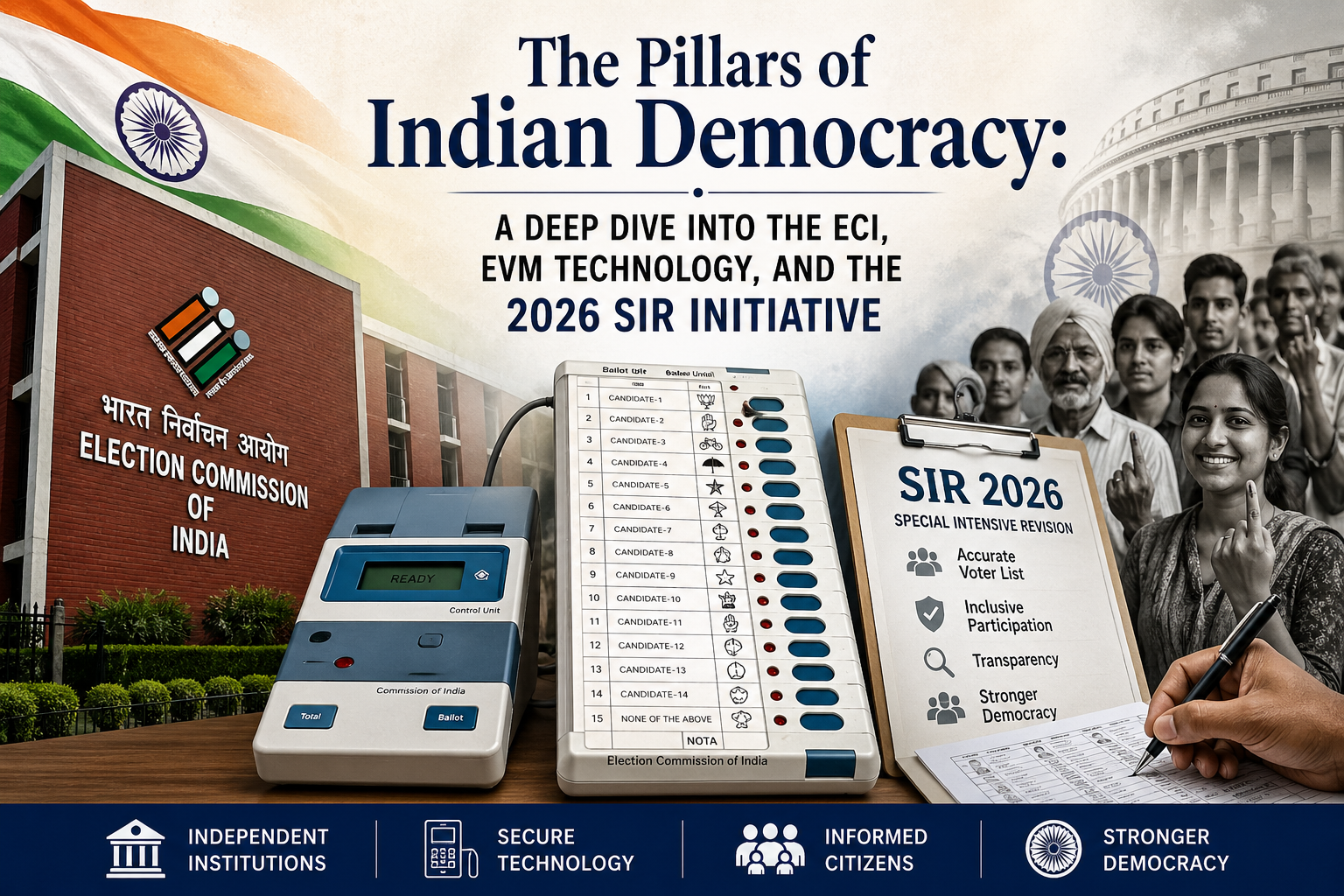
As five states conclude their voting cycles this month, the spotlight is firmly on the Election Commission of India (ECI). In an era of deepfakes and rapid demographic shifts, the ECI’s role has transformed from a mere “logistics manager” to a high-tech guardian of the mandate. This report explores the mechanisms that keep the world’s largest election machinery running.
The Constitutional Mandate: More Than Just Voting (Election Commission of India (ECI)
Established on January 25, 1950, the ECI is an autonomous body under Article 324. While it originally managed only the physical act of voting, its 2026 responsibilities include: (Election Commission of India (ECI))
- The Model Code of Conduct (MCC): Policing political rhetoric and preventing the misuse of state resources.
- Combatting “Digital Poison”: In 2026, the ECI launched its first AI-surveillance wing to flag and remove deepfake campaign videos within a three-hour window.
- Financial Oversight: With seizures in Tamil Nadu and West Bengal surpassing ₹1,000 crores this season, the ECI’s expenditure observers are more active than ever.
EVM & VVPAT: The Science of Your Vote
(Election Commission of India (ECI))
Despite persistent political debate, the ECI maintains that the Electronic Voting Machine (EVM) remains the most secure method of casting a ballot.
Why EVMs are “Unhackable”:
- Standalone Nature: These machines are not connected to any network (Internet, Bluetooth, or Wi-Fi), making remote hacking a technical impossibility. (Election Commission of India (ECI))
- OTP Software: The software is “burnt” into a One-Time Programmable (OTP) chip at the time of manufacture. It cannot be rewritten or modified. (Election Commission of India (ECI))
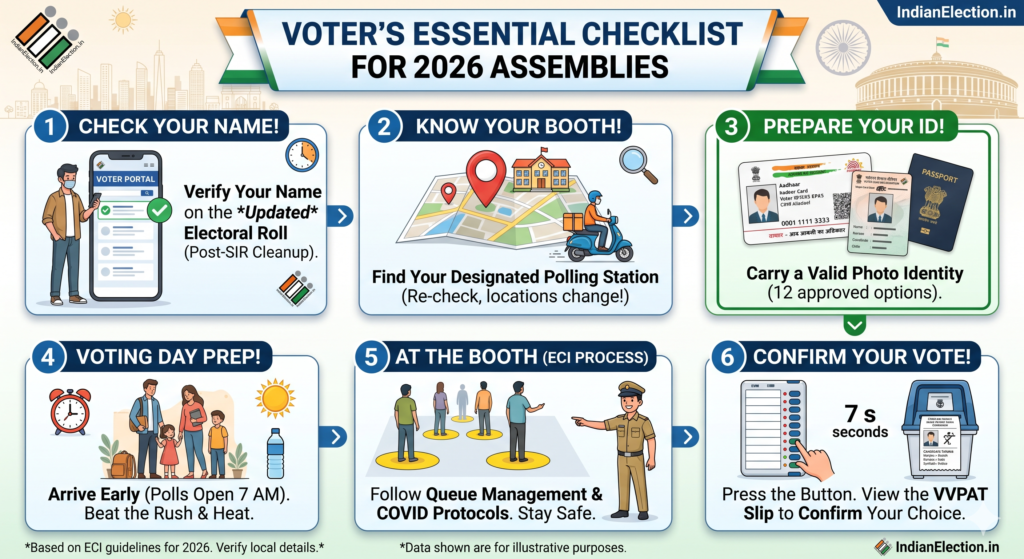
- The VVPAT Safety Net: The Voter Verified Paper Audit Trail (VVPAT) allows you to see a paper slip for 7 seconds, confirming your vote was recorded for your intended candidate. In 2026, the ECI continues the practice of mandatory 5-booth-per-constituency physical slip counting to verify the digital result. (Election Commission of India (ECI))
The 2026 Special Intensive Revision (SIR) (Election Commission of India (ECI))
The most controversial yet necessary exercise this year has been the Special Intensive Revision (SIR). Unlike a routine summary update, the SIR is a house-to-house enumeration process.
- The “Clean-Up” Scale: Since October 2025, over 91 lakh (9.1 million) names were removed from the West Bengal rolls, and a staggering 2.04 crore in Uttar Pradesh.
- The Objective: To remove “ghost voters” (deceased or permanently shifted) and tackle the issue of forged documents used for illegal registrations.
- The Controversy: Opposition parties have raised concerns about potential disenfranchisement, while the ECI maintains the process followed strict judicial oversight to ensure only “non-existent” voters were purged.
Frequently Asked Questions (FAQs)
- General Election Doubts
- Q: What is the difference between an Intensive Revision and a Summary Revision?
- Summary Revision: Most years, the ECI simply asks citizens to update their own data.
- Intensive Revision (SIR): A Booth Level Officer (BLO) physically visits every home to verify who actually lives there. This is a much deeper “audit” of the voter list.
- Q: Can I vote if my name is on the list but I don’t have my EPIC (Voter ID) card?
- Yes. You can vote using any of the 12 alternative photo identity documents approved by the ECI, such as an Aadhaar Card, PAN Card, Driving License, or Passport, provided your name is in the official Electoral Roll.
- EVM & VVPAT Queries
- Q: Can an EVM be “taped” or physically tampered with?
- While there are isolated reports of buttons being obstructed (as alleged in some 2026 phases), this is a physical disruption, not a “hack.” Polling officers are required to clear such obstructions immediately. If the machine is physically opened, the UADM (Unauthorised Access Detection Module) permanently disables it.
- Q: How long are VVPAT slips stored?
- VVPAT slips are kept in sealed boxes for at least 45 days after the result declaration. If a candidate challenges the result in court (Election Petition), they are preserved until the case is resolved.
- The SIR Impact
- Q: My name was deleted during the SIR. What can I do?
- If you were wrongly deleted, you must file Form 6 immediately for re-inclusion. However, once the “Last Date of Nomination” for your constituency passes, no new names can be added for that specific election cycle.
- Q: Is the SIR linked to the NRC?
- No. The ECI has clarified that the SIR is a statutory requirement under the Representation of the People Act, 1950, intended solely for maintaining an accurate voter list for elections, not for citizenship determination.
Read more:
- How to Transfer Voter ID to Another State in India (2026 Complete Guide)
- How to Register a Political Party in India: A Comprehensive Guide
- 5 Major Challenges Facing the Indian Democratic System in 2026
- How to Find Your Polling Booth Near Me (Complete Guide)(Find your polling booth)
- How to Correct Details in Voter ID Online (Name, Address, Age)