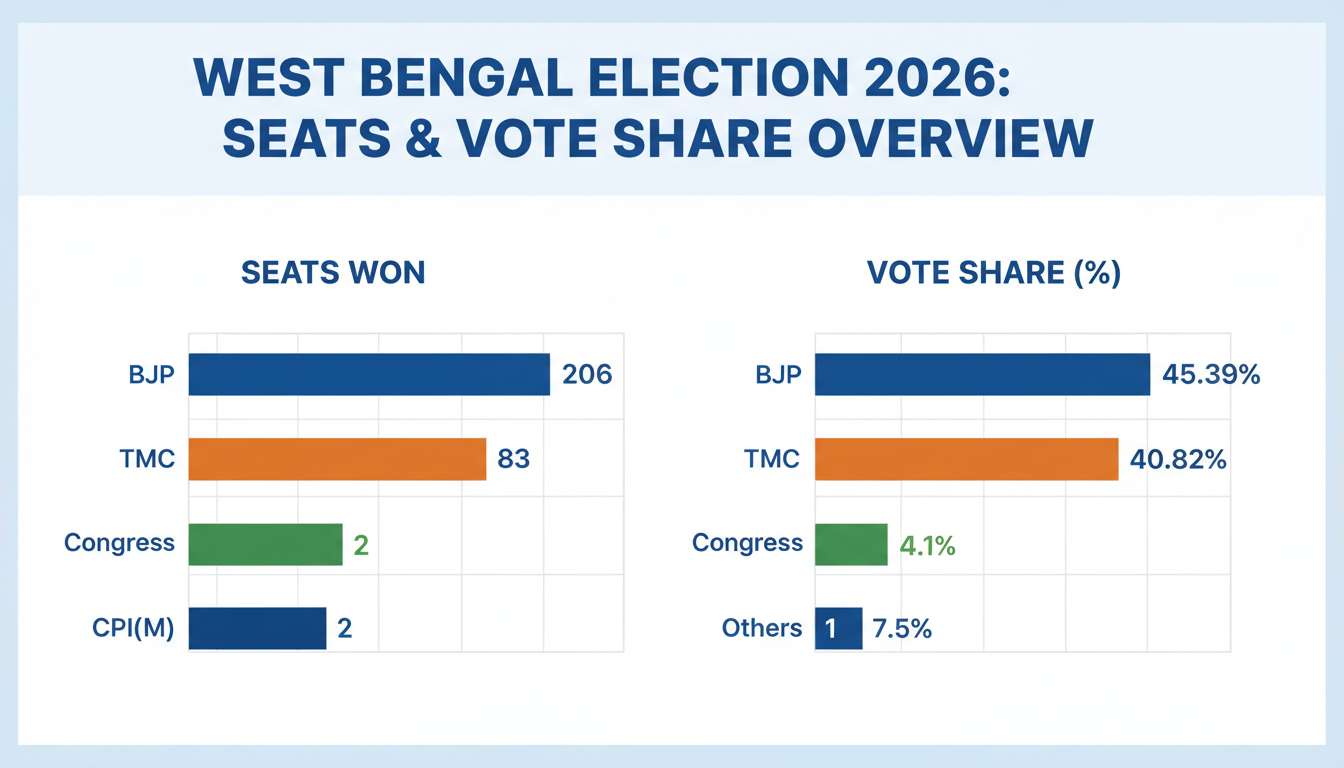
Analysis of election results in West Bengal with data of vote share swing. The 2026 West Bengal Assembly election marked one of the most dramatic political turnovers in India’s recent electoral history. After fifteen years of uninterrupted rule by the All India Trinamool Congress (AITC), led by Mamata Banerjee, the Bharatiya Janata Party (BJP) swept to power, fundamentally reshaping the political landscape of the state. This election was not just about political change, but also about statistical and structural shifts in vote share distribution, voter participation, and constituency-level dynamics.
1. Overview of the Results ( Election Results in West Bengal)
According to official reports, the BJP won 206 out of 294 assembly seats, securing around 45–46% of the total vote share, while the Trinamool Congress managed only 83–84 seats, with about 40–41% of votes. This represents a remarkable inversion of fortunes since 2021, when the TMC had won 215 seats with 45% of votes, and the BJP had only 77 seats with 38% support. The reversal demonstrates a 7-point swing in vote share between the two primary contenders, producing a seat differential of over 120 seats—a striking illustration of the first-past-the-post system’s amplifying effect on small percentage gaps etvbharat.com thehindu.com.
2. Understanding the Swing ( Election Results in West Bengal)
The 2026 results reflected a 5% statewide vote-share difference between BJP (45.8%) and TMC (40.8%), translating to roughly 32 lakh votes in real terms news18.com. This moderate numerical gap, however, led to a huge legislative gap, revealing the geographical and demographic concentration of each party’s voter base. The BJP benefited from even vote dispersion and decisive margins in swing constituencies, while the TMC suffered from vote clustering in urban pockets like Kolkata, where higher margins yielded fewer seats.
In effect, the swing was both geographic and demographic. The BJP made significant gains in northern and southwestern Bengal, including traditionally TMC-dominant districts such as Howrah, South 24 Parganas, and Purba Medinipur. Several coastal and border constituencies also witnessed increased support for the BJP, reflecting successful outreach among the Matua and Scheduled Caste communities.
3. Factors Behind the Vote Swing
( Election Results in West Bengal)
Multiple factors converged to produce this outcome:
- Anti-incumbency sentiment: After 15 years of Trinamool rule, public frustration with perceived corruption, unemployment, and political violence contributed to the swing.
- Organisational resurgence of BJP: The party, bolstered by a better ground network, was able to mobilise rural and first-time voters more efficiently.
- “Special Intensive Revision” (SIR) of voter rolls: The Election Commission’s massive voter list cleanup, which reportedly deleted or reviewed over 90 lakh entries, became a flashpoint. In nearly 50 constituencies, deletions under SIR exceeded the winning margin livemint.com. Analysts have debated whether this disproportionately affected women and Muslim voters—key bases of TMC support.
- Shift in minority and women votes: BJP’s focus on women’s safety and welfare schemes contrasted with the TMC’s reliance on existing welfare programmes, leading to fragmentation in Mamata Banerjee’s traditional support groups firstpost.com.
4. Implications of the 2026 Mandate
( Election Results in West Bengal)
Despite the narrow vote gap, the BJP’s ability to convert votes to seats underscores the efficiency of its electoral strategy and the systemic advantage of the first-past-the-post model. For the TMC, the result signals both an erosion of its core vote base and a critical need to reform organisational structures.
Moreover, this election highlights the increasingly data-sensitive nature of Indian democracy. Administrative exercises such as the SIR and demographic shifts in participation have tangible, and sometimes disproportionate, impacts on outcomes. The 2026 verdict is less a landslide in sentiment than in structure—a case study in how marginal shifts in vote share can yield overwhelming legislative control.
5. Conclusion
(Election Results in West Bengal)
The West Bengal Assembly Election of 2026 will likely be remembered as a turning point in state politics. The BJP’s rise from opposition to dominance reflects a careful alignment of social alliances, administrative precision, and targeted campaigning. Meanwhile, the TMC’s decline illustrates the vulnerabilities of long incumbencies and the volatility of urban-rural voter dynamics.
Statistically, the 5% swing in vote share may appear modest, but politically, it marks a transformational shift—a recalibration of Bengal’s identity and the broader national conversation about governance, representation, and democratic fairness.
West Bengal Assembly Election 2026: Final Results Summary ( Election Results in West Bengal)
| Party | Seats Won | Vote Share (%) | Vote Share (2021) | Vote Swing (2026 vs 2021) |
|---|---|---|---|---|
| Bharatiya Janata Party (BJP) | 206 | 45.39% | 38.15% | +7.24% |
| All India Trinamool Congress (TMC) | 83 | 40.82% | 45.00% | –4.18% |
| Indian National Congress (INC) | 2 | 4.1% | 2.9% | +1.2% |
| CPI(M) | 1 | 2.2% | 2.8% | –0.6% |
| Others/Independents | 2 | 7.5% | 11.1% | –3.6% |
| Total | 294 | — | — | — |
( Election Results in West Bengal)
Voter turnout: 81.6% statewide (a slight dip from 82% in 2021).
Winning margin range: 16 seats decided by less than 2,000 votes.
Largest margin: BJP in Medinipur (over 1.1 lakh votes).
Chief Minister-elect: Suvendu Adhikari (BJP).
How EVM Machines Work in India (Full Breakdown) & Guidance
Key Observations( Election Results in West Bengal)
- The BJP achieved a clean majority with 206 seats, ending Mamata Banerjee’s 15-year rule and forming the government in West Bengal for the first time thehindu.com.
- The TMC vote share fell from 45% to 40.8%, marking a 7% inversion with the BJP compared to 2021 results etvbharat.com.
- The Special Intensive Revision (SIR) of electoral rolls, which deleted around 91 lakh names, had a measurable effect in nearly 50 constituencies where the number of deletions exceeded the winning margins livemint.com.
- Regional trends showed the BJP retaining its northern and southwestern strongholds while breaking into TMC bastions around Kolkata, Howrah, and East Midnapore westbengalelections.site.
In Brief ( Election Results in West Bengal)
- Seats (BJP:TMC) — 206 : 83
- Vote gap — ~4.6%
- Swing — approximately 7% toward BJP compared to 2021
This election demonstrates how modest statewide vote shifts can result in major power realignments under India’s first-past-the-post system, producing one of the clearest inversions of vote-to-seat ratios in Bengal’s political history.

Sources
Frequently Asked Questions (FAQ)
( Election Results in West Bengal)
- Who won the 2026 West Bengal Assembly Election?
- The Bharatiya Janata Party (BJP) won the 2026 election, securing 206 out of 294 seats, defeating the All India Trinamool Congress (TMC), which won 83 seats.
- What was the overall vote share of the major parties?
- The BJP received 45.39% of the votes, while the TMC got 40.82%. The Congress secured around 4.1%, and the Left Front (mainly CPI(M)) around 2.2%.
- How big was the vote share swing compared to 2021?
- The BJP saw a positive swing of approximately 7.2%, while the TMC’s vote share declined by about 4.2 percentage points.
- How did small changes in vote share lead to such a big shift in seats?
- India’s first-past-the-post system means even slight vote share differences can lead to major seat changes when opposition votes consolidate or split differently.
- What regions contributed most to the BJP’s victory?
- BJP performed strongly in North Bengal, South-West Bengal, and border districts such as Nadia and East Midnapore, while also gaining ground in urban centers like Howrah and Kolkata suburbs.
- Did the “Special Intensive Revision” (SIR) of the voter list affect results?
- The SIR reportedly removed or updated about 91 lakh voter records across the state. In some constituencies, the number of deletions was higher than the margin of victory, sparking debate on its effect on the final outcome.
- Who is the new Chief Minister of West Bengal?
- Suvendu Adhikari, a senior BJP leader and former TMC minister, was sworn in as the Chief Minister following the BJP’s majority win.
- What was the voter turnout in 2026?
- The overall voter turnout was 81.6%, slightly lower than the 82% turnout in 2021, indicating continued high political engagement across the state.
- What are the key takeaways from this election?
- A major realignment of voter loyalties after 15 years of TMC rule.
- Demonstration of how organizational strength and vote distribution can outweigh raw vote totals.
- A reminder of the importance of electoral rolls, grassroots campaigning, and data-driven politics in determining modern Indian elections.
- What does this result mean for Bengal’s future politics?
- The 2026 result sets up a new era of multipolar competition, with the BJP now the dominant force, the TMC rebuilding its base, and smaller parties trying to stay relevant. Future politics will likely revolve around governance reforms, economic revival, and regional identity.
- ( Election Results in West Bengal)
For authentic data and information visit : Election Commission Of India
Read more : Election Commission of India: Roles & Powers Explained (Complete Guide)
A Tectonic Shift in Tamil Nadu Politics: The 2026 Verdict Analysis
The Assam Election Results 2026: A Hattrick for Stability and the NDA