Introduction
India, the world’s largest democracy, conducts elections on a massive scale involving millions of voters. To manage such a complex process efficiently, the country uses Electronic Voting Machines (EVMs) instead of traditional ballot papers.
To understand elections better, you should also read our complete guide on the voting process in India.
👉
/voting-process-in-india
Official website of Election Commission of India Click Here
EVMs have made voting faster, more reliable, and less prone to errors, but many voters still have questions about how they actually function.
- What happens when you press the button?
- Where does your vote go?
- Is the system truly secure?
In this detailed guide, you’ll get a complete breakdown of how EVM machines work in India, including their components, voting process, security features, and counting system.
What is an EVM?
An Electronic Voting Machine is a standalone electronic device used to record votes during elections in India. These machines are designed and manufactured by government-owned companies like BEL (Bharat Electronics Limited) and ECIL (Electronics Corporation of India Limited).
👉 The most important thing to understand is:
EVMs are NOT connected to the internet, WiFi, or any external network.
This makes them highly secure and resistant to hacking.
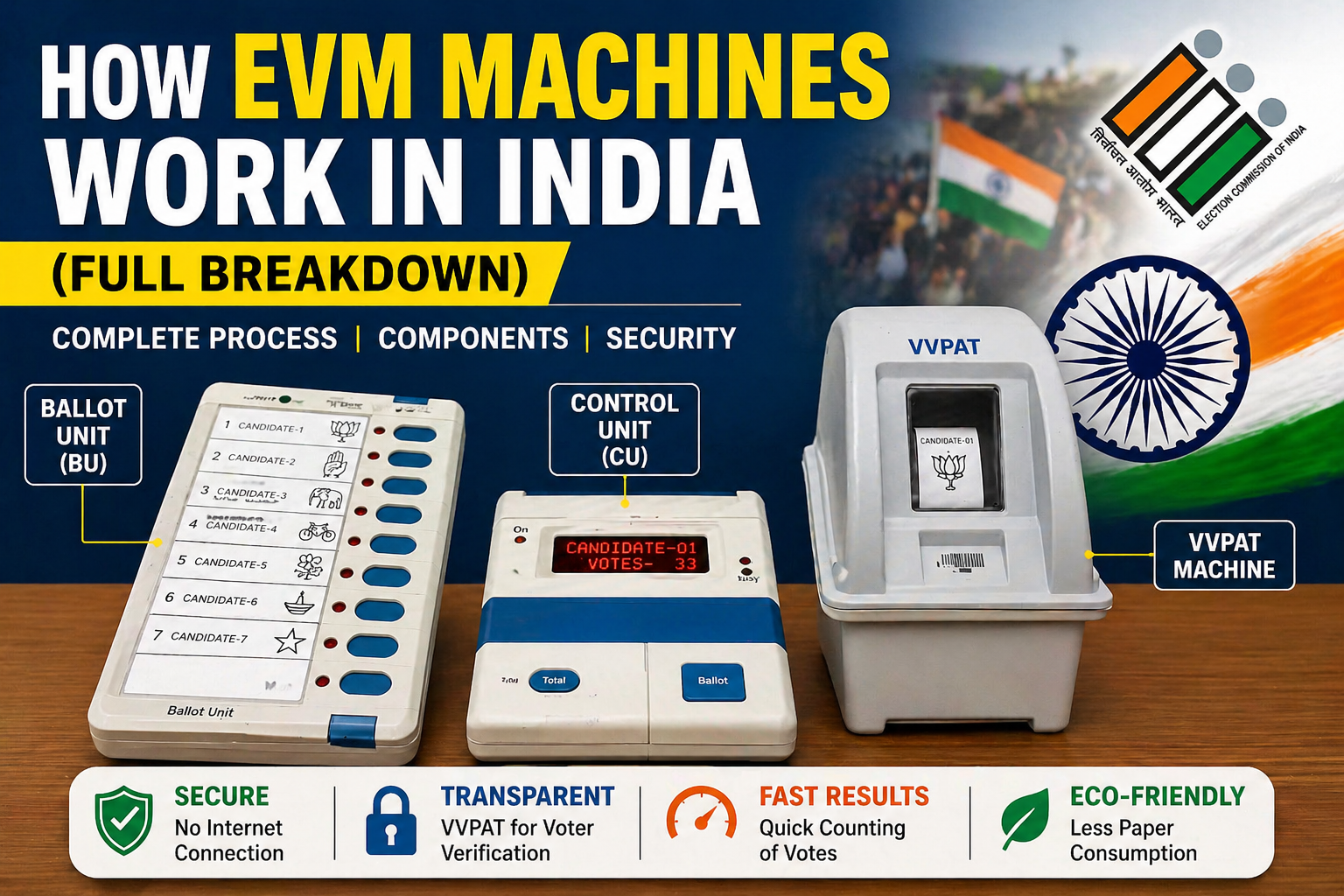
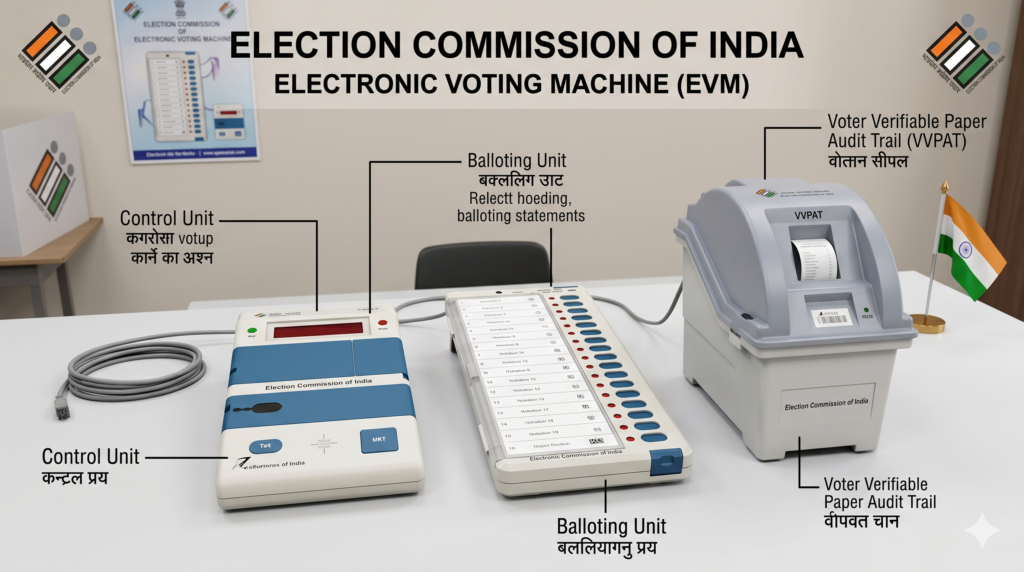
Main Components of an EVM
An EVM is not just one machine—it is a system made up of three key parts:
1- Ballot Unit (BU)
The Ballot Unit is the part that voters interact with directly.
Features:
- Displays candidate names and election symbols
- Has a blue button next to each candidate
- Connected to the Control Unit via a cable
How it works:
When a voter presses a button:
- A red LED light glows
- A beep sound confirms the vote
This is the moment your vote is recorded.
2- Control Unit (CU)
The Control Unit is operated by the polling officer and acts as the brain of the system.
Features:
- Stores all votes securely
- Controls when a voter can vote
- Displays total number of votes
Key Role:
👉 No one can vote unless the polling officer activates the machine.
This ensures:
- Only one vote per person
- No unauthorized voting
3- VVPAT Machine
The VVPAT (Voter Verifiable Paper Audit Trail) adds transparency to the voting process.
What happens:
- After pressing a button, a paper slip is generated
- It shows the candidate’s name and symbol
- The slip is visible for about 7 seconds
- Then it falls into a sealed box
This allows voters to visually confirm their vote.
Step-by-Step Voting Process
Understanding the actual voting process helps remove confusion and builds trust.
🪜 Step 1: Voter Verification
- The voter arrives at the polling booth
- Identity is verified using Voter ID or other approved documents
- Finger is marked with indelible ink
👉 This prevents duplicate voting
🪜 Step 2: Activation of EVM
- Polling officer activates the Control Unit
- This enables the Ballot Unit for one vote
👉 Without activation, the machine does not accept input
🪜 Step 3: Casting the Vote
- Voter enters private voting compartment
- Presses button next to preferred candidate
Immediately:
- Red light glows
- Beep sound is heard
👉 Vote is recorded securely
🪜 Step 4: VVPAT Confirmation
- VVPAT displays paper slip
- Shows selected candidate details
- Slip drops into sealed box automatically
👉 Provides an additional verification layer
Read:
🔐 Security Features of EVM Machines
Security is one of the strongest aspects of EVMs. Multiple layers ensure that the system remains tamper-proof.
🔒 Key Security Measures:
1. No Network Connectivity
- EVMs are standalone devices
- No internet, Bluetooth, or WiFi
👉 Cannot be hacked remotely
👉 Cannot be hacked remotely
2. Physical Sealing
- Machines are sealed with signatures of officials
- Tampering becomes immediately visible
3. Randomization
- Machines are randomly assigned to polling booths
- Prevents manipulation planning
4. Mock Poll Testing
- Conducted before voting begins
- Ensures machine is working correctly
5. Strong Room Storage
- After voting, EVMs are stored in secure strong rooms
- Guarded by security forces
- Monitored with CCTV cameras
6. Multi-Level Verification
- Political party representatives can observe the process
- Ensures transparency
What Happens After Voting?
Storage of EVMs
- Machines are sealed immediately after polling
- Transported securely to counting centers
- Stored under tight security
Counting of Votes
On counting day:
- Control Unit is opened
- Results are displayed instantly
- Data is recorded and verified
Counting takes minutes instead of hours or days
Advantages of EVM Machines
EVMs have significantly improved the election system in India.
Key Benefits:
- ⚡ Faster counting of votes
- ❌ No invalid or rejected votes
- 🌱 Environment-friendly (no paper ballots)
- 🔐 Highly secure system
- 💰 Reduces long-term election costs
❗ Common Myths About EVMs
❓ Myth 1: EVMs Can Be Hacked
👉 Reality:
EVMs are not connected to any network, making hacking extremely difficult.
❓ Myth 2: Votes Can Be Changed
👉 Reality:
Once recorded, votes cannot be altered.
❓ Myth 3: Machines Malfunction Frequently
👉 Reality:
Strict testing and backup systems ensure smooth functioning.
Who Manages EVMs in India?
EVMs are managed and monitored by the Election Commission of India (ECI).
They are manufactured by:
- Bharat Electronics Limited (BEL)
- Electronics Corporation of India Limited (ECIL)
👉 Both are government-owned and highly regulated organizations.
Conclusion
Electronic Voting Machines have transformed the way elections are conducted in India. By replacing paper ballots, EVMs have made the voting process faster, more efficient, and more secure.
With features like:
- Standalone design
- Strict security protocols
- VVPAT verification system
👉 EVMs ensure that every vote is counted accurately.
Understanding how these machines work not only builds trust but also empowers you as a responsible voter in a democratic nation.
Read more:
- The Pillars of Indian Democracy: A Deep Dive into the Election Commission of India (ECI), EVM Technology, and the 2026 SIR Initiative
- How to Transfer Voter ID to Another State in India (2026 Complete Guide)
- How to Register a Political Party in India: A Comprehensive Guide
- 5 Major Challenges Facing the Indian Democratic System in 2026
🔎 FAQs (Frequently Asked Questions)
- Q1. What is the full form of VVPAT?
- 👉 Voter Verifiable Paper Audit Trail
- Q2. How many votes can an EVM store?
- 👉 Around 2000 votes
- Q3. Are EVMs used in all elections in India?
- 👉 Yes, in Lok Sabha and State Assembly elections
- Q4. When were EVMs introduced in India?
- 👉 First used in 1982, widely adopted after 2000