Election Results
- West Bengal Election Results 2026
- Tamil Nadu Election Results 2026
- Assam Election Results 2026
- Kerala Election Results 2026
- Puducherry Election Results 2026
Official Website of Election Commission of India
📌 Introduction (Election Commission of India)
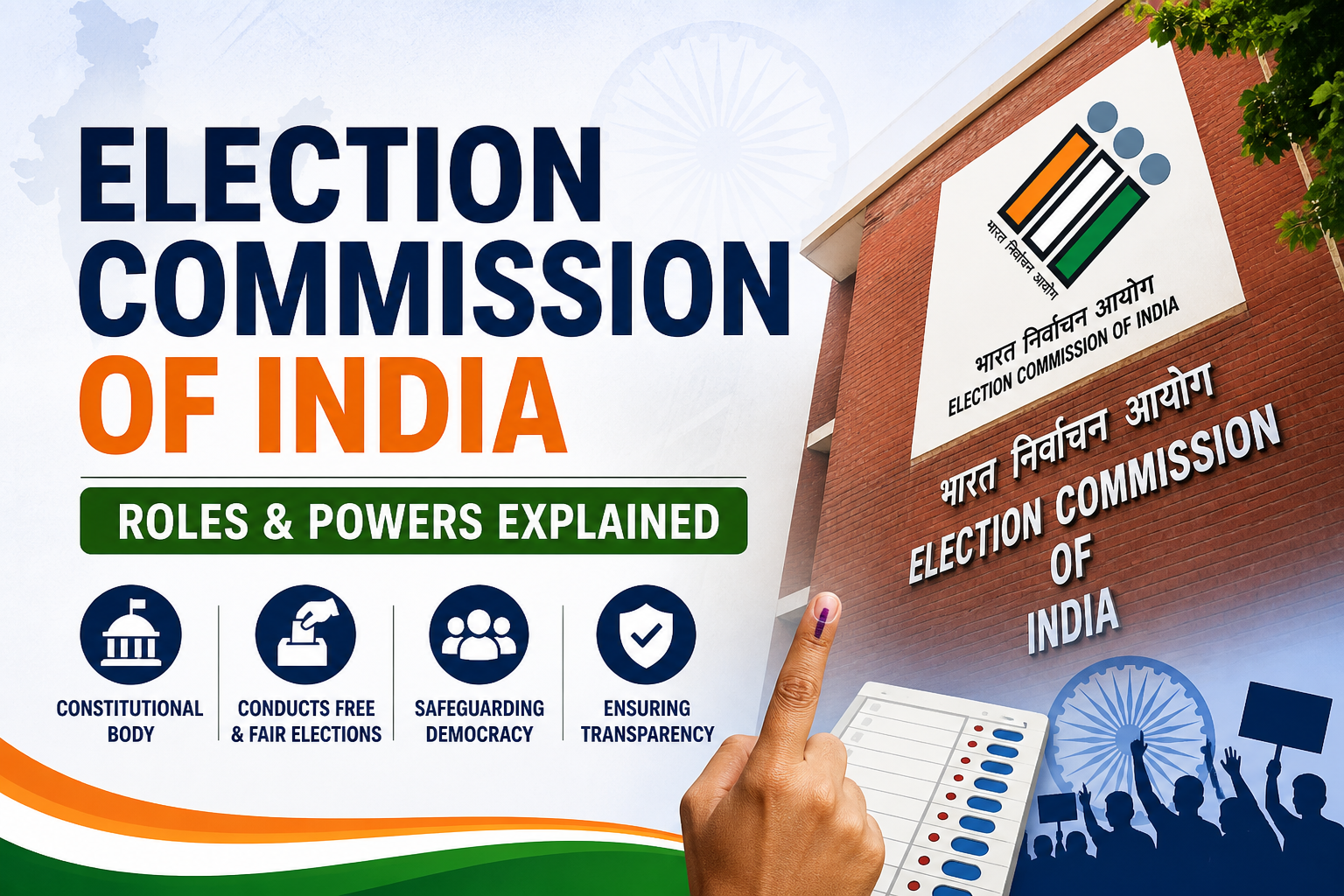
The Election Commission of India (ECI) is one of the most important pillars of Indian democracy. It ensures that elections in the country are conducted in a free, fair, and transparent manner. In a nation as vast and diverse as India, conducting elections smoothly is a massive responsibility—and the ECI handles it with authority and precision.
Established on 25 January 1950, the Election Commission is a constitutional body that supervises elections at both national and state levels. From preparing voter lists to announcing results, its role is crucial in maintaining the integrity of the democratic process.
In this detailed guide, you will learn about the roles, powers, functions, and importance of the Election Commission of India.
🧠 What is the Election Commission of India?
The Election Commission of India is an independent constitutional authority created under Article 324 of the Indian Constitution. Its main responsibility is to supervise, direct, and control elections across the country.
The ECI conducts elections for:
- Lok Sabha (House of the People)
- Rajya Sabha (Council of States)
- State Legislative Assemblies
- President of India
- Vice-President of India
However, elections for local bodies like Panchayats and Municipalities are conducted by State Election Commissions.
🏛️ Structure of the Election Commission of India
The Election Commission is a three-member body consisting of:
- Chief Election Commissioner (CEC)
- Two Election Commissioners
All members are appointed by the President of India. The structure ensures balanced decision-making and independence from political pressure.
The Chief Election Commissioner has security of tenure and cannot be removed easily, which strengthens the neutrality of the Commission.
🎯 Key Roles of the Election Commission of India
1. Conducting Free and Fair Elections
The primary role of the ECI is to ensure that elections are conducted without bias. It prepares the election schedule, sets polling dates, and oversees the entire voting process.
This ensures that every citizen gets an equal opportunity to vote without interference.
Gyanesh Kumar Chief Election Commissioner of India
2. Preparing and Updating Voter Lists
The Commission prepares and maintains electoral rolls (voter lists). It regularly updates these lists to include new voters and remove duplicate or invalid entries.
This guarantees that all eligible citizens can participate in elections.
3. Registration of Political Parties
Political parties must register with the Election Commission. The ECI also grants recognition as national or state parties based on their performance.
It also allocates election symbols to parties, which helps voters easily identify candidates.
4. Monitoring Election Campaigns
The Election Commission enforces the Model Code of Conduct (MCC), which sets rules for political parties during elections.
It ensures that:
- No misuse of government resources takes place
- No hate speech or unfair practices are used
- Campaigns remain ethical and lawful
5. Controlling Election Expenses
To ensure fair competition, the ECI sets limits on how much a candidate can spend during elections. It monitors expenses and requires candidates to submit reports.
This prevents wealthy candidates from gaining an unfair advantage.
6. Declaring Election Results
After voting is completed, the Election Commission supervises the counting of votes and officially declares the results.
With the use of Electronic Voting Machines (EVMs), results are announced quickly and accurately.
⚖️ Powers of the Election Commission of India
The ECI has significant powers that allow it to function effectively.
🔹 Administrative Powers
These include:
- Conducting elections at various levels
- Appointing election officers and observers
- Managing polling booths and logistics
- Enforcing the Model Code of Conduct
These powers ensure smooth election operations.
🔹 Advisory Powers
The Election Commission advises:
- The President on disqualification of Members of Parliament (MPs)
- The Governors on disqualification of Members of Legislative Assembly (MLAs)
Its advice is considered highly important in such matters.
🔹 Quasi-Judicial Powers
The ECI acts like a court in certain situations. It can:
- Resolve disputes between political parties
- Decide on symbol allocation issues
- Handle election-related complaints
This makes it a powerful authority in maintaining fairness.
🔹 Powers Under Article 324
Article 324 of the Constitution gives the Election Commission complete control over elections.
This includes:
- Scheduling elections
- Conducting polls
- Supervising the entire process
The Supreme Court has also supported the wide powers of the ECI under this article.
🔐 How ECI Ensures Free and Fair Elections
The Election Commission uses multiple systems to ensure transparency and fairness:
- Model Code of Conduct to regulate political behavior
- Electronic Voting Machines (EVMs) and VVPAT for transparent voting
- Appointment of election observers
- Deployment of security forces to maintain law and order
- Strict monitoring of candidates and parties
These measures ensure that elections are conducted without manipulation.
📊 Importance of Election Commission in Democracy
The Election Commission plays a crucial role in maintaining democracy in India.
Its importance includes:
- Protecting voter rights
- Ensuring equal opportunity for candidates
- Preventing corruption and malpractice
- Maintaining trust in the electoral system
Without the ECI, free and fair elections would not be possible.
⚠️ Challenges Faced by the Election Commission
Despite its strong powers, the ECI faces several challenges:
- Spread of fake news and misinformation
- Influence of money power in elections
- Criminalization of politics
- Low voter awareness in some areas
However, the Commission continuously improves its systems to tackle these issues.
🧾 Conclusion
The Election Commission of India is the backbone of the country’s democratic system. With its constitutional authority and wide-ranging powers, it ensures that elections are conducted fairly and transparently.
From managing voter lists to declaring results, the ECI plays a vital role in shaping the future of the nation. Understanding its functions helps citizens become more aware and responsible voters.
🔎 FAQs
What is the Election Commission of India?
It is a constitutional body responsible for conducting elections in India.
Under which article is the Election Commission established?
It is established under Article 324 of the Indian Constitution.
How many members are there in the Election Commission?
There are three members: one Chief Election Commissioner and two Election Commissioners.
What are the main powers of the Election Commission?
The main powers include administrative, advisory, and quasi-judicial powers.
Does the Election Commission conduct local elections?
No, local elections are conducted by State Election Commissions.
What is the Model Code of Conduct?
It is a set of guidelines that political parties must follow to ensure fair elections.
Read More:
- How EVM Machines Work in India (Full Breakdown) & Guidance
- The Pillars of Indian Democracy: A Deep Dive into the Election Commission of India (ECI), EVM Technology, and the 2026 SIR Initiative
- How to Transfer Voter ID to Another State in India (2026 Complete Guide)
- How to Register a Political Party in India: A Comprehensive Guide
- A Tectonic Shift in Tamil Nadu Politics: The 2026 Verdict Analysis
- Analysis of Election Results in West Bengal with Data of Vote Share Swing (2026)