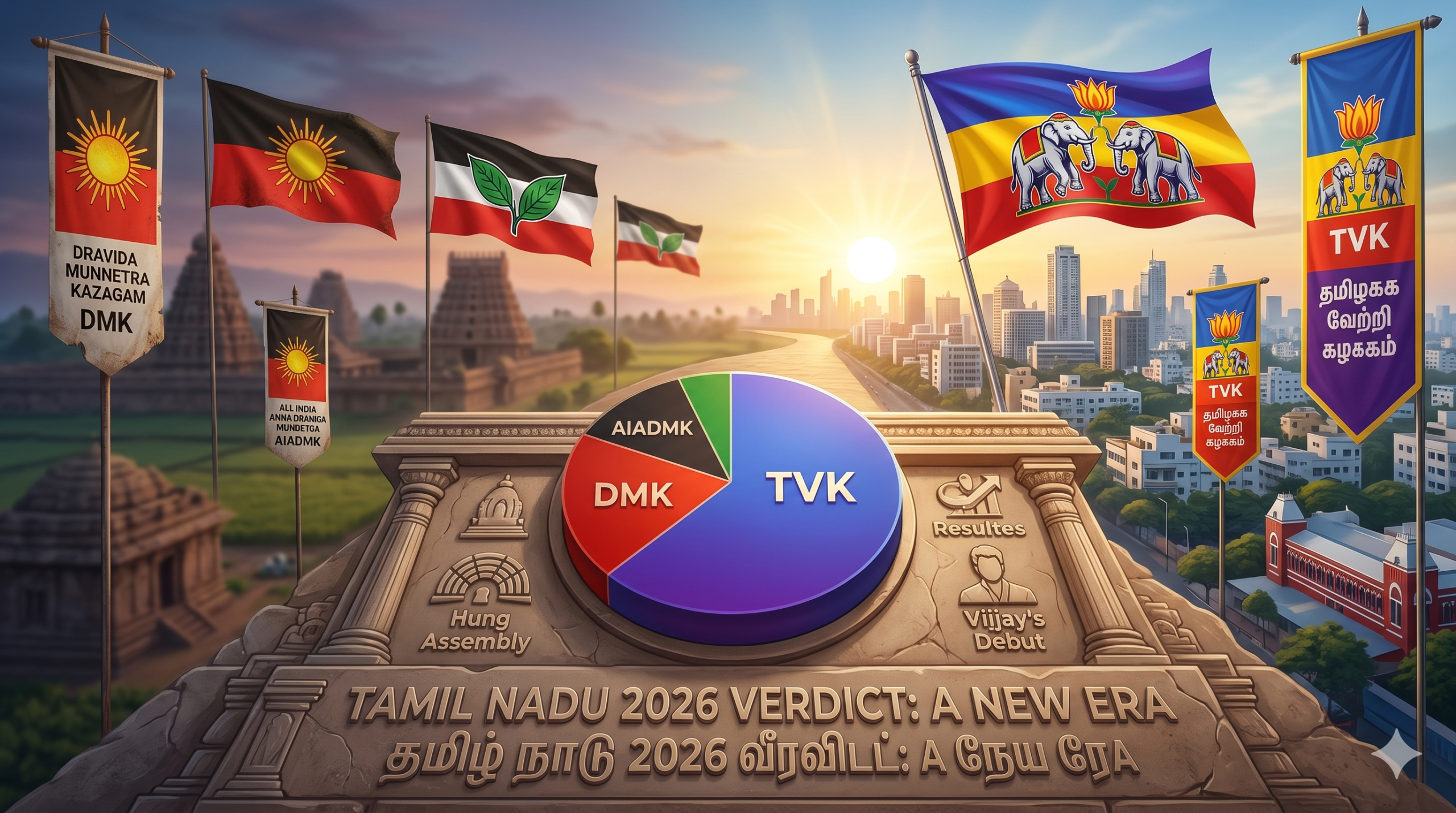
Tamil Nadu Election Results. The 2026 Tamil Nadu Assembly Election has shattered a five-decade-old bipolar political structure. For the first time since 1967, a “third force” has not only challenged but surpassed the two Dravidian titans, the DMK and AIADMK. The result is a historic mandate that has left the state with its first-ever hung assembly and a brand-new political order.
Election Results :
- West Bengal Election Results 2026
- Tamil Nadu Election Results 2026
- Assam Election Results 2026
- Kerala Election Results 2026
- Puducherry Election Results 2026
Based on official data from the Election Commission of India (ECI) and Wikipedia, here is a comprehensive analysis of the numbers, trends, and the high-stakes negotiations defining this election. (Tamil Nadu Election Results)
1. The Headline: TVK’s Historic Debut
The 2026 election belonged to Thalapathy Vijay’s Tamilaga Vettri Kazhagam (TVK). Emerging from its 2024 launch, TVK secured 108 seats—the most successful debut for a single party in Tamil Nadu’s history, surpassing the records set by M.G. Ramachandran’s ADMK in 1977. (Tamil Nadu Election Results)
Final Seat Tally (234 Total)
| Party / Alliance | 2026 Seats Won | Vote Share % | Change from 2021 |
|---|---|---|---|
| TVK (Solo) | 108 | 35.1% | +108 |
| DMK (SPA) | 59 | 24.2% | -74 |
| AIADMK (NDA) | 47 | 21.1% | -19 |
| INC (Congress) | 5 | 3.2% | -13 |
| PMK (NDA) | 4 | 3.8% | -1 |
| VCK | 2 | 1.8% | -2 |
| CPI / CPI(M) | 4 | 2.1% | -4 |
| BJP (NDA) | 1 | 3.1% | -3 |
| Others | 4 | 5.6% | – |
2. The “Kingmakers”: Coalition Math for 118 (Tamil Nadu Election Results)
With TVK at 108 seats, the state is currently in a state of intense political maneuvering. Vijay needs 10 more MLAs (or 11, considering one seat must be vacated as he won two) to stake a claim.
- The Congress Factor (5 Seats): In a late-night development on May 5th, the Congress Political Affairs Committee authorized support for TVK to form a “secular government.” Sources suggest Congress is seeking two cabinet berths.
- The Left & VCK (6 Seats): The CPI (2), CPI(M) (2), and VCK (2) hold the remaining keys. If these former DMK allies shift to TVK, Vijay comfortably crosses the 118 mark.
- The “Secular” Condition: The Congress and VCK have placed a firm condition: TVK must not seek support from the BJP or any of its NDA partners (AIADMK/PMK).
3. Performance of the National & Regional Veterans (Tamil Nadu Election Results)
The BJP: A Lone Warrior
Despite a high-decibel campaign led by central leaders, the BJP saw its tally drop from 4 seats to just 1 seat. Bhojarajan M (Udhagamandalam) was the sole winner for the saffron party. High-profile candidates like Tamilisai Soundararajan (Mylapore) and L. Murugan (Avanashi) faced defeats, with the TVK absorbing much of the urban anti-incumbency vote that the BJP had hoped to capture.
The PMK: Retaining the North
The Pattali Makkal Katchi (PMK) managed to hold onto 4 seats in the Vanniyar-dominated northern belt, showing that localized identity politics remains resilient even against a statewide wave. However, their influence as a swing factor has diminished compared to previous cycles.
The VCK & Left: Caught in the Crossfire
The Viduthalai Chiruthaigal Katchi (VCK) and the Communist parties were significantly squeezed by the TVK’s dominance. While they retained a handful of seats, their vote shares dwindled as the Dalit and labor youth vote migrated toward Vijay’s “Social Justice 2.0” platform.
4. Why the Giants Fell: The “Giant Killer” Moments
- Kolathur: In the election’s most shocking result, TVK’s V. S. Babu defeated sitting CM M.K. Stalin. This loss is being viewed as a verdict against the DMK’s dynastic image and the local administration’s handling of urban infrastructure.
- Perambur & Trichy (East): TVK Chief Vijay proved his mettle by winning both constituencies with margins exceeding 50,000 votes, cementing his status as the state’s most popular leader.
- AIADMK’s Struggle: While Edappadi K. Palaniswami won Edappadi by nearly 1 lakh votes, his party finished a distant third. The AIADMK’s inability to project itself as the primary alternative to the DMK allowed TVK to occupy that space.
- (Tamil Nadu Election Results)
5. Manifesto & Governance: The Path Ahead (Tamil Nadu Election Results)
TVK’s rise was fueled by a promise of “Scientific Welfare.” Key pillars include:
- The ₹2,500 “Magalir Urimai” Top-up: Increasing the existing women’s assistance.
- Ministry of AI: A first-in-India proposal to use technology for corruption-free governance.
- Village-level Jobs: The “CM People Service Associate” program to decentralize employment.
6. Conclusion: A New Era
As of May 7th, 2026, Tamil Nadu stands at a crossroads. The mandate is a clear rejection of the “Dravidian Duopoly.” Whether Vijay forms a coalition government with the Congress and Left or faces a period of political instability, the “Vijay Wave” has fundamentally altered the DNA of Tamil Nadu politics. The era of the “Third Pole” has finally arrived.
Frequently Asked Questions: 2026 Tamil Nadu Election Results
Here are the most common questions regarding the historic 2026 Tamil Nadu Assembly Election results and the current state of politics.
The Election Outcome
Q: Why is this election being called “historic”? A: It marks the end of the five-decade-old bipolar political structure in Tamil Nadu. For the first time since 1967, neither the DMK nor the AIADMK secured a dominant majority. The emergence of the Tamilaga Vettri Kazhagam (TVK) as the single largest party represents a fundamental shift in the state’s political landscape.
Q: Did the Chief Minister lose his seat? A: Yes. In a major shock to the incumbent DMK, Chief Minister M.K. Stalin lost his home constituency of Kolathur to TVK candidate V.S. Babu. This is the first time in recent history that a sitting Chief Minister has lost their seat, signaling a significant level of anti-incumbency.
Q: What was the voter turnout for this election? A: Tamil Nadu recorded an unprecedented voter turnout of 84.8%, the highest in the state’s history. This high level of engagement, particularly among youth and urban voters, was a primary driver for the dramatic shift in results.
Government Formation & Coalition Math (Tamil Nadu Election Results)
Q: Why is there a “Hung Assembly”? A: A party needs 118 seats to form a simple majority in the 234-seat Tamil Nadu Legislative Assembly. The TVK emerged as the single largest party with 108 seats, falling 10 seats short of the magic number. Consequently, no single party has the mandate to form a government independently. (Tamil Nadu Election Results)
Q: Who are the “Kingmakers” in this scenario? A: The smaller parties holding the balance of power include the Congress (5 seats), the VCK (2 seats), and the Left parties (CPI and CPI(M) – 4 seats total). Their support is essential for any major party to reach the 118-seat threshold. (Tamil Nadu Election Results)
Q: Will TVK form a coalition government? A: As of now, negotiations are ongoing. The Congress party has signaled potential support for a “secular government,” but the formation of a stable administration depends on whether TVK can successfully consolidate support from the smaller parties without compromising its “secular” conditions set by the potential allies. (Tamil Nadu Election Results)
TVK & The “Vijay Wave” (Tamil Nadu Election Results)
Q: What led to the TVK’s massive electoral success?
A: Analysts point to a combination of factors: Thalapathy Vijay’s massive fan base mobilized into a voting block, a strong anti-incumbency sentiment against the DMK, and a manifesto that focused on “scientific welfare,” specifically addressing economic concerns of youth and women.
Q: What is the “Ministry of AI” mentioned in the manifesto?
A: A key pillar of the TVK campaign was the proposal to create a dedicated Ministry of Artificial Intelligence. The party aims to use AI to modernize governance, reduce bureaucratic corruption, and streamline service delivery for citizens.
Q: Is there any risk of instability for the new government?
A: In a hung assembly, coalition governments often face challenges regarding stability. The government’s longevity will likely depend on the strength of the alliance agreements and the ability of the TVK to maintain consensus among its coalition partners on key legislative issues.
Read also : Analysis of Election Results in West Bengal with Data of Vote Share Swing (2026)
- How EVM Machines Work in India (Full Breakdown) & Guidance
- The Pillars of Indian Democracy: A Deep Dive into the Election Commission of India (ECI), EVM Technology, and the 2026 SIR Initiative
- The Assam Election Results 2026: A Hattrick for Stability and the NDA
- The Great Shift: Kerala Assembly Election 2026 Results Analysis
Data Sources: ECI Trends & Results (May 2026), The Hindu, NDTV Live Updates, Wikipedia Contributors.
Disclaimer : Visit Election Commission of India for latest updates