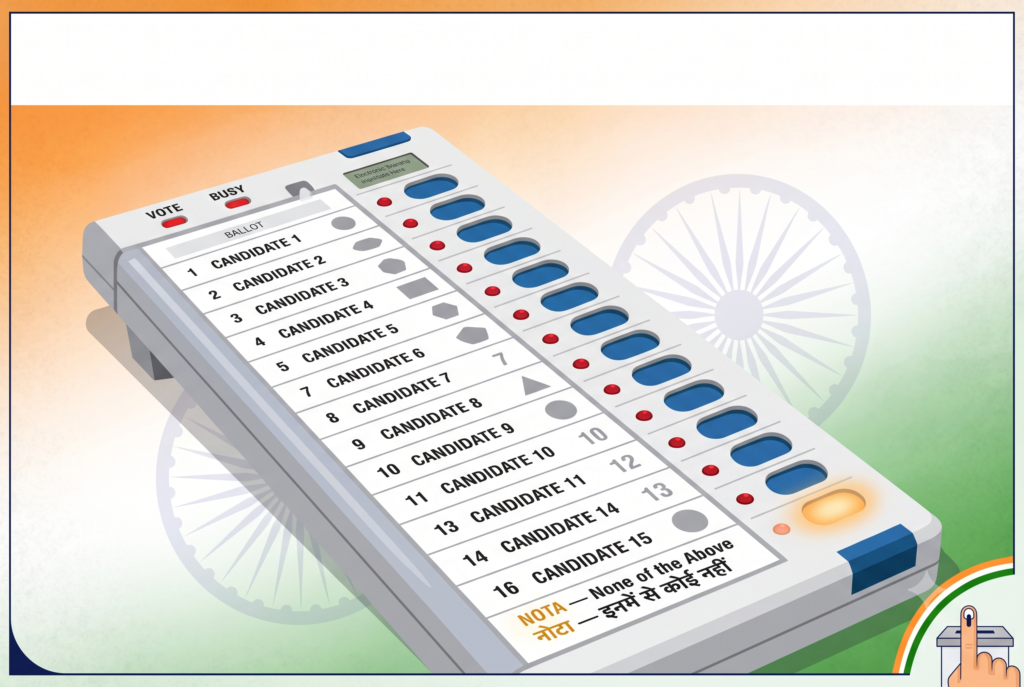
Every election, lakhs of Indian voters walk into the polling booth, look at the list of candidates, feel unimpressed by all of them — and press the last button on the EVM instead. It’s labelled NOTA, short for “None of the Above.”
But here’s the question almost nobody actually knows the answer to: what happens to that vote afterward? Does it cancel the election? Does it force a re-vote? Or does it just vanish into a counting sheet, changing nothing?
The truth is more interesting — and more limited — than most people assume. This guide breaks down exactly what NOTA is, how it works on the EVM, what the Election Commission of India (ECI) and Supreme Court have ruled, and why your NOTA vote matters even though it can’t “defeat” a candidate.
What is NOTA?
NOTA stands for “None of the Above.” It is an option available to every voter in India that allows them to formally reject all contesting candidates in their constituency without abstaining from voting altogether.
Instead of skipping the election entirely — which the Election Commission actively discourages — a voter who is dissatisfied with every candidate can still walk in, get their finger inked, and register a legal, counted vote that says: “None of these candidates deserve my support.”
When Was NOTA Introduced in India?
NOTA was introduced following a landmark Supreme Court judgment in September 2013, in the case of People’s Union for Civil Liberties (PUCL) vs. Union of India. The Supreme Court held that the right to cast a negative vote is a facet of the fundamental right to freedom of expression under Article 19(1)(a) of the Constitution, and directed the Election Commission to provide a NOTA button.
NOTA was first used in the 2013 Assembly elections of five states (Chhattisgarh, Madhya Pradesh, Mizoram, Rajasthan, and Delhi), and later in the 2014 Lok Sabha general election, making it available nationwide.
Where Do You Find NOTA on the EVM?
NOTA is not hidden or optional — it is a mandatory button on every ballot unit of the Electronic Voting Machine, positioned as the last option after the final candidate’s name, marked with a distinct black-and-white symbol showing a ballot paper with a black cross on it.
If you want to understand how the rest of the EVM works before or after casting a NOTA vote, our detailed breakdown on how EVM machines work in India covers the full voting and counting mechanism.
Does NOTA Cancel an Election or Force a Re-Election?
This is the single biggest myth around NOTA — and the answer is no, not in India.
Unlike some countries where a majority “reject all” vote can void an election, in India, NOTA has no legal power to invalidate results, no matter how many votes it receives. Here’s what actually happens:
- The candidate with the highest number of individual votes wins — even if NOTA receives more votes than every candidate individually.
- NOTA votes are counted, published, and recorded, but they are treated as invalid votes for the purpose of declaring a winner.
- There is no threshold or trigger in Indian election law that forces a re-poll based on NOTA numbers.
This is different from what many voters believe after seeing viral social media claims suggesting “if NOTA gets the most votes, the election is cancelled.” That is currently not the law in India, despite being debated in courts and by the Election Commission itself.
Has NOTA Ever “Won” a Seat in India?
Yes — NOTA has won the highest vote share in several local body and panchayat elections, particularly in states like Maharashtra and Chhattisgarh, where certain state election rules do require a re-election if NOTA gets the most votes at that local level. However, at the state Assembly and Lok Sabha level, no such rule exists nationally, and the candidate with the most valid candidate-votes is declared the winner regardless of NOTA’s tally.
Why Vote NOTA If It Can’t Change the Result?
Even though NOTA can’t defeat a candidate outright, it still serves real, documented purposes:
- It’s officially recorded and made public. High NOTA numbers in a constituency send a visible signal about voter dissatisfaction, and are tracked by political analysts, media, and parties themselves.
- It protects your right to participate without endorsing anyone. Before NOTA, a dissatisfied voter’s only options were to abstain (weakening turnout data) or vote for someone they didn’t support.
- It preserves voter secrecy. Earlier, voters who wanted to formally reject candidates had to sign a physical register under Rule 49-O, which compromised their anonymity. NOTA removed that entirely — your rejection is now as private as any other vote.
- It can influence future candidate selection. Parties do study high-NOTA constituencies when deciding who to field next time.
NOTA vs Rule 49-O: What Changed
| Rule 49-O (Before 2013) | NOTA (After 2013) | |
|---|---|---|
| Method | Voter had to sign a register at the booth | Voter presses a button on EVM |
| Secrecy | Not fully anonymous | Fully anonymous |
| Counted as a vote | Not officially treated as a cast vote | Registered and counted, but invalid for result purposes |
| Legal basis | Conduct of Election Rules, 1961 | Supreme Court directive, 2013 |
Does Pressing NOTA Waste Your Vote?
No. This is a common misconception. A NOTA vote is not wasted in the sense that it is fully recorded, reported in official ECI results, and counted toward total voter turnout. What it does not do is subtract from any individual candidate’s vote count or block anyone from winning. Your civic participation is captured either way — you just don’t hand your support to a specific name on the ballot.
The Ongoing Debate: Should NOTA Have “Teeth”?
The Election Commission of India has, at various points, formally recommended to the Law Ministry that if NOTA receives more votes than every candidate, a fresh election should be held with new candidates — effectively giving NOTA real electoral consequences. This proposal has been discussed for years but has not yet become law at the national level. Until Parliament amends the Representation of the People Act to include such a provision, NOTA in national and state elections will remain a powerful expression tool without a binding electoral outcome.
Quick Summary: What NOTA Does and Doesn’t Do
NOTA does:
- Let you formally and privately reject all candidates
- Get counted and published in official ECI data
- Count toward total voter turnout
- Send a visible signal of voter dissatisfaction
NOTA does not:
- Cancel an election, nationally or at the state level
- Force a re-election under current national law
- Reduce any candidate’s actual vote total
- Guarantee anonymity is compromised (it’s fully secret)
Related reading: How EVM Machines Work in India | Election Commission of India: Roles & Powers Explained | Voter ID Card vs e-EPIC: The Complete Truth
Frequently Asked Questions (FAQ)
Q1. What does NOTA mean in Indian elections?
NOTA stands for “None of the Above.” It’s a voting option that lets a voter formally reject all contesting candidates in their constituency while still casting a valid, counted vote.
Q2. Is NOTA available in all elections in India?
Yes, NOTA is available in Lok Sabha elections, state Assembly elections, and most local body elections across India, since it became a nationwide requirement after the 2013 Supreme Court ruling.
Q3. Can NOTA winning the most votes cancel an election?
No, not at the national or state Assembly level. The candidate with the highest individual vote count still wins even if NOTA receives more votes overall. Some state-specific panchayat/local body rules do allow a re-election if NOTA wins, but this is not a nationwide rule.
Q4. Is a NOTA vote counted as a valid vote?
It is recorded and reported in official results and counted toward voter turnout, but it is treated as invalid for the purpose of determining which candidate wins the seat.
Q5. Where is the NOTA button located on the EVM?
NOTA is always the last button on the EVM ballot unit, appearing after the final contesting candidate’s name and symbol, marked with a distinctive black-and-white crossed-ballot symbol.
Q6. Does pressing NOTA reveal who I rejected?
No. Your NOTA vote is completely anonymous, exactly like every other vote cast on the EVM. This is a major improvement over the earlier Rule 49-O system, which required voters to sign a register.
Q7. Can NOTA votes be higher than the winning candidate’s votes?
Yes, this has happened in various constituencies over the years, most notably in local body elections. However, it does not change who is declared the winner under current national election law.
Read Also : Voter ID Card vs e-EPIC: Which One is Valid for Voting in 2026? The Complete Truth
The Great Shift: Kerala Assembly Election 2026 Results Analysis