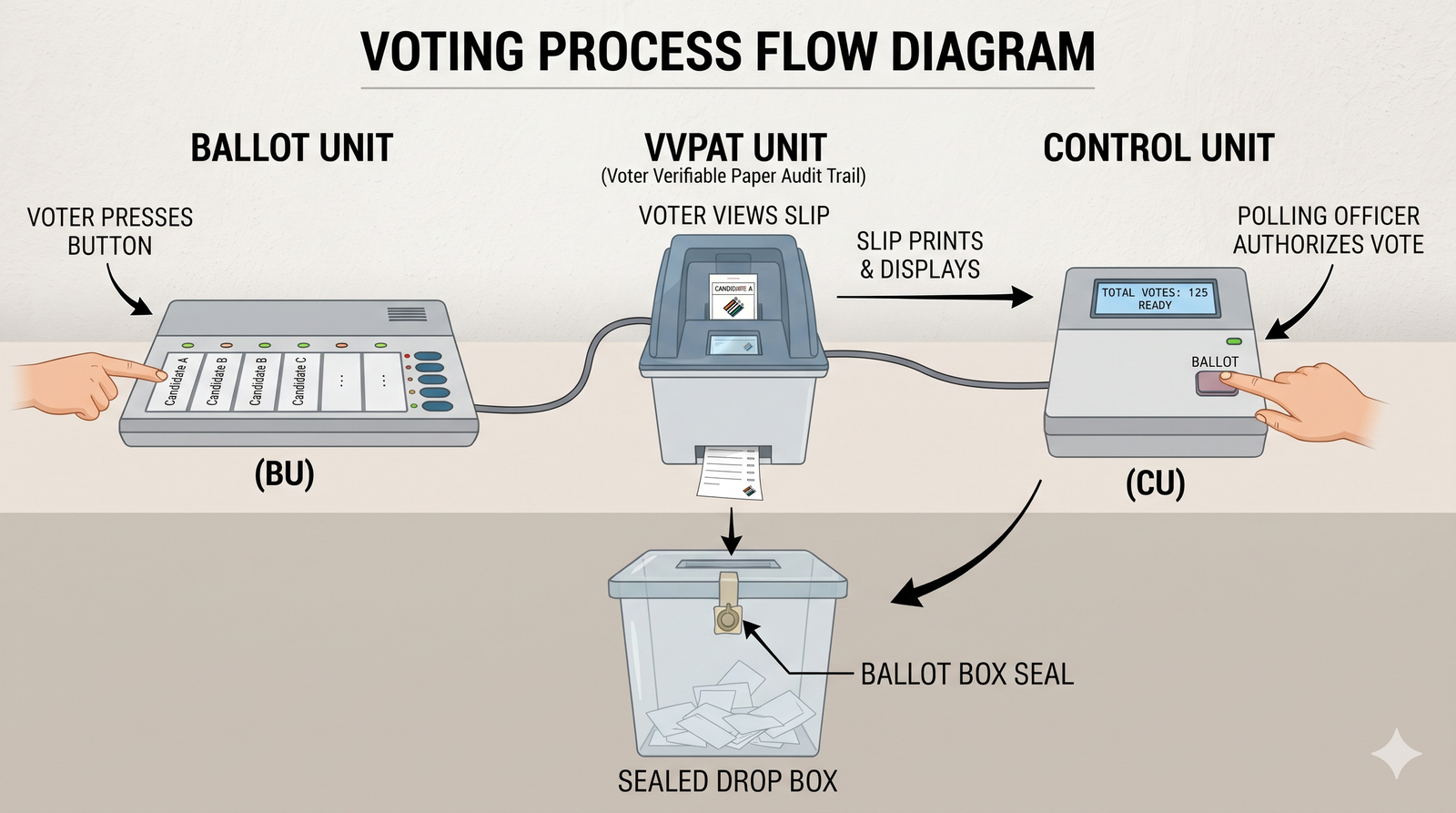
What Is VVPAT? If you have voted in recent years, you have probably noticed a small glass window next to the voting machine where a slip lights up for a few seconds and then disappears. That machine is called the VVPAT, and it exists for one reason: to let you check that your vote was recorded the way you meant it.
This guide explains what VVPAT is, how it works, what you actually see when you vote, how it is different from the EVM, and how the paper slips are counted after polling day.
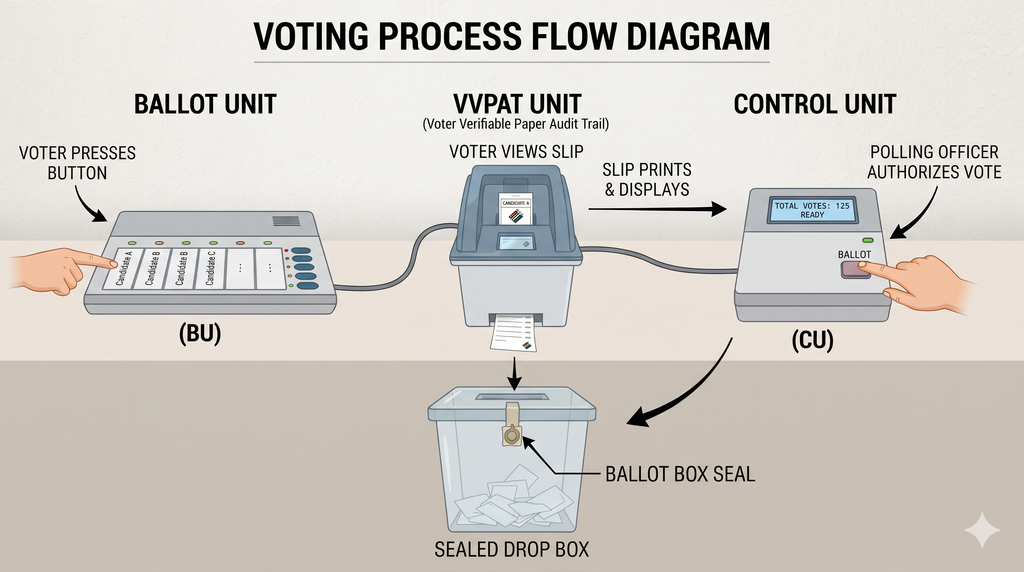
What does VVPAT stand for?
VVPAT stands for Voter Verifiable Paper Audit Trail. Let us break that into plain words:
- Voter verifiable: you, the voter, can check it yourself.
- Paper audit trail: it leaves a paper record that officials can go back to if there is a question about the count.
In short, VVPAT is a printer attached to the voting machine. When you press a button, it prints a small slip showing whom you voted for. You see the slip, and then it drops into a sealed box.
Why was VVPAT introduced?
Electronic voting machines (EVMs) record votes in electronic memory. That is fast and avoids invalid ballots, but some voters and parties asked a fair question: how can a voter be sure the machine registered the vote correctly?
VVPAT is the answer to that question. It gives each voter a quick visual check, and it gives the Election Commission a physical record to compare with the machine’s count if needed. VVPAT was first tried in a by-election at Noksen in Nagaland in 2013, and it has since been used in all constituencies in general elections.
How is VVPAT different from the EVM?
People often think VVPAT and EVM are the same thing. They are two machines that work together.
| EVM | VVPAT | |
|---|---|---|
| What it is | The voting machine, made of a Ballot Unit and a Control Unit | A printer unit attached to the Ballot Unit |
| What it does | Records and stores the votes electronically | Prints a paper slip for each vote |
| What the voter does | Presses the blue button next to a candidate | Looks at the slip in the window |
| Does the voter keep anything? | No | No. The slip falls into a sealed box |
| Used for counting? | Yes, this is the main count | Only for verification in selected polling stations |
The Ballot Unit is the part you press. The Control Unit is operated by the polling officer. The VVPAT sits in between and is part of the same chain. If you want to see how the machines work together in detail, read our guide to how EVMs work in India.
What does the voter see? Step by step
Here is exactly what happens in the voting compartment. If you want the full journey from the queue to the ink mark, see our guide to the voting process in India.
- You press the blue button next to your candidate on the Ballot Unit.
- A red light glows beside your choice and you hear a long beep.
- The VVPAT window lights up. A slip appears showing the candidate’s serial number, name and party symbol.
- The slip stays visible for about seven seconds. This is your time to check that it matches your choice.
- The slip is cut and drops into a sealed compartment inside the VVPAT. You cannot touch it or take it with you.
That is all. The voter does not need to do anything with the slip. The point is simply to look.
What if the slip shows the wrong candidate?
Do not leave. Tell the presiding officer immediately. Procedures exist for this situation, so ask the officer to explain them. Raising a false complaint knowingly can have legal consequences, so be sure of what you saw.
Why can’t the voter take the slip home?
There are two reasons. First, it protects the secrecy of the vote. If people could carry out a slip showing who they voted for, someone could pressure them to prove their choice. Second, the slips are the official audit record, so they must stay in the sealed box under the Commission’s control. The Supreme Court has also said that handing slips to voters is not a workable idea.
How are VVPAT slips counted?
In most polling stations, the VVPAT slips are not counted on counting day. The votes are counted from the EVM Control Units. But a sample of VVPAT slips is counted and matched with the EVM count as a check. Here is how that works.
The current rule: five polling stations per assembly segment
In April 2019, the Supreme Court directed the Election Commission to raise the number of polling stations where VVPAT slips are verified. Earlier, the check was done in one randomly selected polling station per assembly constituency. The Court raised it to five.
So for each assembly constituency (or each assembly segment inside a Lok Sabha constituency):
- Five polling stations are picked at random. The Returning Officer does this by a draw of lots.
- The draw is done openly, in front of the candidates or their agents and the observer appointed by the Commission.
- The slips are counted physically, after the last round of counting of votes recorded in the EVMs is finished.
- The slip count is compared with the count shown on the EVM Control Unit for the same polling station.
What if the numbers don’t match?
Under the Commission’s procedure, as widely reported, the paper slip count is taken as final for that polling station. The Maharashtra Chief Electoral Officer, for example, publicly confirmed after the 2024 elections that VVPAT slip counts of the randomly selected polling stations matched the EVM counts. ECI Handbook
Why not count every slip?
Several petitions asked for 100% matching of VVPAT slips with EVM results. The Election Commission argued that this would take much more time and effectively bring back the delays of paper ballots. In April 2024, a two-judge bench of the Supreme Court (Justices Sanjiv Khanna and Dipankar Datta) rejected the demand for 100% verification and rejected a return to paper ballots. The Court said that blind doubt can breed unnecessary scepticism, but it also added two safeguards:
- Symbol Loading Units (SLUs) must be sealed and stored with the EVMs after the candidate symbols are loaded.
- A losing candidate can ask for a check. The candidates who finish second or third can request, in writing within seven days of the result, that engineers from the EVM manufacturers verify the burnt memory (microcontroller) in up to 5% of the EVMs per assembly constituency or segment. The candidate pays the cost, and the cost is refunded if tampering is found. The District Election Officer certifies the result of this check.
The Court also observed that the Commission could consider whether VVPAT slips could be counted with machines, for example with barcodes, in the future.
Voter Helpline 1950 / Voter Services Portal
Common questions about VVPAT
Is VVPAT used in every polling station?
Yes. VVPATs are attached to the voting machines at all polling stations. The sample counting is only for the randomly selected stations.
Can VVPAT slips be counted for a recount?
A recount or special verification depends on the Returning Officer’s orders, the Commission’s rules and, if challenged, an election petition before a High Court. If you are a candidate or agent, ask the Returning Officer for the exact procedure in writing.
Does VVPAT make voting slower?
Only slightly. The slip stays visible for about seven seconds, which adds a few moments for each voter.
Can a VVPAT slip show something different from my vote?
The system is designed so that the machine prints what was recorded, and the sample counting exists to catch mismatches. If you see a slip that does not match your button press, report it to the presiding officer at once.
Is VVPAT the same as a paper ballot?
No. A paper ballot is the vote itself. A VVPAT slip is only a record to check the electronic vote.
More questions about how VVPAT works
What is the VVPAT Status Display Unit (VSDU)?
VVPAT has two parts. The printer sits in the voting compartment beside the Ballot Unit. The VSDU is a small display kept on the presiding officer’s table, and it shows the machine’s status, such as a low battery or a printer fault. One extra polling official is assigned to keep an eye on it for the whole day of polling.
Does VVPAT need a mains power connection?
No. According to the Election Commission’s FAQ on VVPAT, it runs on a battery pack of 15 volts, so it works even where the power supply is unreliable.
When was VVPAT first used in India?
The Government of India amended the Conduct of Elections Rules, 1961 on 14 August 2013 to allow VVPAT to be used with EVMs. It was first used in the bye-election to the Noksen (ST) assembly constituency in Nagaland.
Who checks the VVPAT machines before an election?
The first level check is done only by authorised engineers of the two manufacturers, Bharat Electronics Limited (BEL) and Electronics Corporation of India Limited (ECIL). Representatives of political parties are present, and the check is recorded on video.
How do candidates’ names and symbols get into the VVPAT?
After the final list of candidates is ready, the manufacturers’ engineers load the serial numbers, names and symbols into each VVPAT. A test printout is then compared with the ballot paper fixed on the Ballot Unit. After that, one test vote is cast for each candidate to confirm that the right slip prints every time.
What is a mock poll and what happens to its slips?
Before real voting begins, a mock poll is held to show that the machine works. Afterwards, the presiding officer must clear the mock poll data from the Control Unit and take out all the mock slips from the VVPAT drop box. Each slip is stamped “MOCK POLL SLIP” on the back and sealed in a thick black envelope, so these slips never get mixed with real votes.
What if I think the slip shows the wrong candidate?
Say so to the presiding officer right away. Under the Conduct of Elections Rules, the officer first warns you about the consequences of a false claim and takes your declaration in writing. The officer then makes a second entry about you in Form 17A, and you are allowed to cast a test vote in front of the officer and any candidates or polling agents present. If the slip from that test vote shows the wrong candidate, the officer informs the Returning Officer, stops further voting on that machine and follows the Returning Officer’s directions. If the slip matches your test vote, the allegation is treated as false, a remark is recorded, and you sign or give a thumb impression against it. Test votes are subtracted from the candidate’s total at counting, so they do not affect the result. Never make a claim you are not sure about, because a false declaration can lead to legal action.
What happens if a VVPAT develops a fault while voting is on?
If the display unit shows a low battery message, the battery pack is replaced at once. If it shows a printer error, the whole VVPAT is replaced with a new one. Staff are not allowed to change the paper roll at a polling station. According to the Commission’s FAQ, a fresh mock poll is not needed when a VVPAT or EVM is replaced during polling.
Is counting of VVPAT slips compulsory?
It depends on which rule you are reading. The Commission’s older FAQ on VVPAT says counting is not compulsory, and that a candidate or agent can make a written request, which the Returning Officer decides. That FAQ appears to be older than the Supreme Court’s April 2019 order. Today, counting the slips of five randomly selected polling stations per assembly segment is mandatory, as explained above. For anything beyond that, the Returning Officer’s written orders and the Commission’s latest instructions apply.
What happens to the slips after the result is declared?
Once the result is announced, the slips are taken out of the VVPAT drop box, whether or not they were counted. They are kept in a sealed envelope of thick black paper, closed with red wax and the Commission’s secret seal held by the Returning Officer. The paper roll and the battery are also removed from the VVPAT.
Why are VVPATs stored separately from EVMs after counting?
The Commission’s FAQ explains that the VVPAT units are kept in a separate strong room because their slips have already been removed and sealed. This means the VVPAT units are free for use in the next election, even if an election petition keeps the EVMs locked up.
Where can I learn more?
The Election Commission of India publishes FAQs and handbooks at eci.gov.in. For help as a voter, call the Voter Helpline on 1950.
Sources to cite:
- Supreme Court of India, order of 8 April 2019 on VVPAT verification in five polling stations per assembly segment (reported by Business Standard, Bar and Bench and The Quint)
- Supreme Court of India, judgment of 26 April 2024 rejecting 100% VVPAT verification and issuing safeguards (reported by LiveLaw, SC Observer and Deccan Herald)
- Election Commission of India: https://eci.gov.in (FAQs and Handbook for Returning Officers)
- Maharashtra Chief Electoral Officer statement on VVPAT slip matching (Deccan Herald report)
Written by Mahboob Ali. Last reviewed: 14 November 2026. This site is independent and not connected with the Election Commission of India. Rules and procedures can change, so confirm details on the official portal.
3 thoughts on “What Is VVPAT? How Paper Slip Verification Works in India”