The Great Shift: Kerala Assembly Election 2026 Results Analysis. Kerala has long been the final frontier for Communist politics in India and a bastion of a unique “alternating” power struggle. However, the 2026 Assembly Election results have delivered a verdict that many are calling a “watershed moment.” After a historic second term for the Pinarayi Vijayan-led LDF (2021–2026), the pendulum has swung back with unprecedented force.
The Big Picture: A Historic Landslide
( Kerala Assembly Election 2026)
The 2026 results show a decisive victory for the United Democratic Front (UDF), led by the Indian National Congress.
- UDF Performance: Secured a commanding majority (leads/wins in over 85–90 seats), reclaiming its position after a decade in the opposition.
- LDF Performance: The Left Democratic Front saw a significant contraction, dropping from its 2021 high of 99 seats to nearly half that number.
- NDA Impact: While the BJP-led NDA struggled to translate vote share into many seats, it maintained a decisive presence in 5–7 key constituencies, acting as a crucial “spoiler” in several triangular contests.
Key Factors Behind the Verdict ( Kerala Assembly Election 2026)
A. The Economic Burden: Debt & Unemployment
The LDF government faced intense scrutiny over Kerala’s mounting public debt, which touched nearly ₹4.5 lakh crore. While welfare kits and social security pensions helped the LDF win in 2021, the “fiscal crisis” narrative dominated 2026.
- Youth Disillusionment: A critical factor was the wage disparity. Educated youth found that starting salaries (₹12k–₹15k) were lower than daily manual labor wages (₹1k+), leading to a massive “brain drain” to Europe and the West. This disillusioned the young voter base.
B. The “Anti-Incumbency” & Fatigue Factor
After 10 years of Pinarayi Vijayan’s “Captain” persona, the electorate showed signs of “voter fatigue.” Allegations of “ministerial arrogance” and controversial statements by cabinet members alienated middle-class pressure groups and religious communities that had previously supported the Left.
C. The UDF’s Revival Strategy
The Congress-led UDF successfully capitalized on the “negative vote” against the LDF. By fielding “popular faces” and focusing on a manifesto centered on “Infrastructure & Global Jobs,” they managed to win back the Christian and Muslim belts in central and northern Kerala—regions that had drifted toward the LDF in 2021.
Regional Breakdown
- South Kerala (Thiruvananthapuram & Kollam): Traditionally an LDF stronghold, several “safe seats” saw major upsets as the UDF made deep inroads.
- Central Kerala (The Christian Belt): The return of the Kerala Congress (M) influence and a shift in the Syrian Christian vote back toward the UDF was a turning point.
- North Kerala (Malabar): The IUML (Indian Union Muslim League) consolidated its base, ensuring that the UDF dominated the Malappuram and Kozhikode regions.
The End of an Era?
The 2026 result is not just a change of government; it marks the total erasure of Left-governed states in India (following losses in West Bengal in 2011 and Tripura in 2018). For the CPI(M), this is a moment of deep introspection. For the UDF, it is a mandate to fix the state’s shattered finances.
Data Table: Comparative Analysis (2021 vs. 2026)( Kerala Assembly Election 2026)
In the context of the 2026 Kerala Assembly Elections, the political landscape of God’s Own Country has undergone a seismic shift. For your website, indianelection.in, here is a high-value, detailed analysis of the results and the underlying factors that reshaped Kerala’s political history.
The Great Shift: Kerala Assembly Election 2026 Results Analysis( Kerala Assembly Election 2026)
Kerala has long been the final frontier for Communist politics in India and a bastion of a unique “alternating” power struggle. However, the 2026 Assembly Election results have delivered a verdict that many are calling a “watershed moment.” After a historic second term for the Pinarayi Vijayan-led LDF (2021–2026), the pendulum has swung back with unprecedented force. ( Kerala Assembly Election 2026)
1. The Big Picture: A Historic Landslide
The 2026 results show a decisive victory for the United Democratic Front (UDF), led by the Indian National Congress.
- UDF Performance: Secured a commanding majority (leads/wins in over 85–90 seats), reclaiming its position after a decade in the opposition.
- LDF Performance: The Left Democratic Front saw a significant contraction, dropping from its 2021 high of 99 seats to nearly half that number.
- NDA Impact: While the BJP-led NDA struggled to translate vote share into many seats, it maintained a decisive presence in 5–7 key constituencies, acting as a crucial “spoiler” in several triangular contests.
2. Key Factors Behind the Verdict ( Kerala Assembly Election 2026)
A. The Economic Burden: Debt & Unemployment
The LDF government faced intense scrutiny over Kerala’s mounting public debt, which touched nearly ₹4.5 lakh crore. While welfare kits and social security pensions helped the LDF win in 2021, the “fiscal crisis” narrative dominated 2026.
- Youth Disillusionment: A critical factor was the wage disparity. Educated youth found that starting salaries (₹12k–₹15k) were lower than daily manual labor wages (₹1k+), leading to a massive “brain drain” to Europe and the West. This disillusioned the young voter base.
B. The “Anti-Incumbency” & Fatigue Factor
After 10 years of Pinarayi Vijayan’s “Captain” persona, the electorate showed signs of “voter fatigue.” Allegations of “ministerial arrogance” and controversial statements by cabinet members alienated middle-class pressure groups and religious communities that had previously supported the Left. +1
C. The UDF’s Revival Strategy
The Congress-led UDF successfully capitalized on the “negative vote” against the LDF. By fielding “popular faces” and focusing on a manifesto centered on “Infrastructure & Global Jobs,” they managed to win back the Christian and Muslim belts in central and northern Kerala—regions that had drifted toward the LDF in 2021.
3. Regional Breakdown( Kerala Assembly Election 2026)
- South Kerala (Thiruvananthapuram & Kollam): Traditionally an LDF stronghold, several “safe seats” saw major upsets as the UDF made deep inroads.
- Central Kerala (The Christian Belt): The return of the Kerala Congress (M) influence and a shift in the Syrian Christian vote back toward the UDF was a turning point.
- North Kerala (Malabar): The IUML (Indian Union Muslim League) consolidated its base, ensuring that the UDF dominated the Malappuram and Kozhikode regions.
4. The End of an Era?
The 2026 result is not just a change of government; it marks the total erasure of Left-governed states in India (following losses in West Bengal in 2011 and Tripura in 2018). For the CPI(M), this is a moment of deep introspection. For the UDF, it is a mandate to fix the state’s shattered finances.
5. Data Table: Comparative Analysis (2021 vs. 2026)
| Alliance | 2021 Seats Won | 2026 Seats (Estimated/Actual) | Key Swing Factor |
|---|---|---|---|
| LDF | 99 | 40 – 45 | Anti-incumbency, Fiscal Crisis |
| UDF | 41 | 85 – 92 | Youth Vote, Minority Consolidation |
| NDA | 0 | 3 – 5 | Consolidation of Hindu Votes in Urban Pockets |
Data Deep-Dive: The 2026 Kerala Election Verdict
The 2026 results represent a “double-digit” swing in voter sentiment. Below is a comparative breakdown of the seat shares, vote percentages, and the critical “swing” factors that decided the fate of the three major fronts.
1. Comparative Seat Distribution (2021 vs. 2026)
The transition from a dominant LDF majority to a UDF landslide is the most defining feature of this election. ( Kerala Assembly Election 2026)
| Alliance | 2021 Actual Seats | 2026 Actual Seats | Net Change | Performance Status |
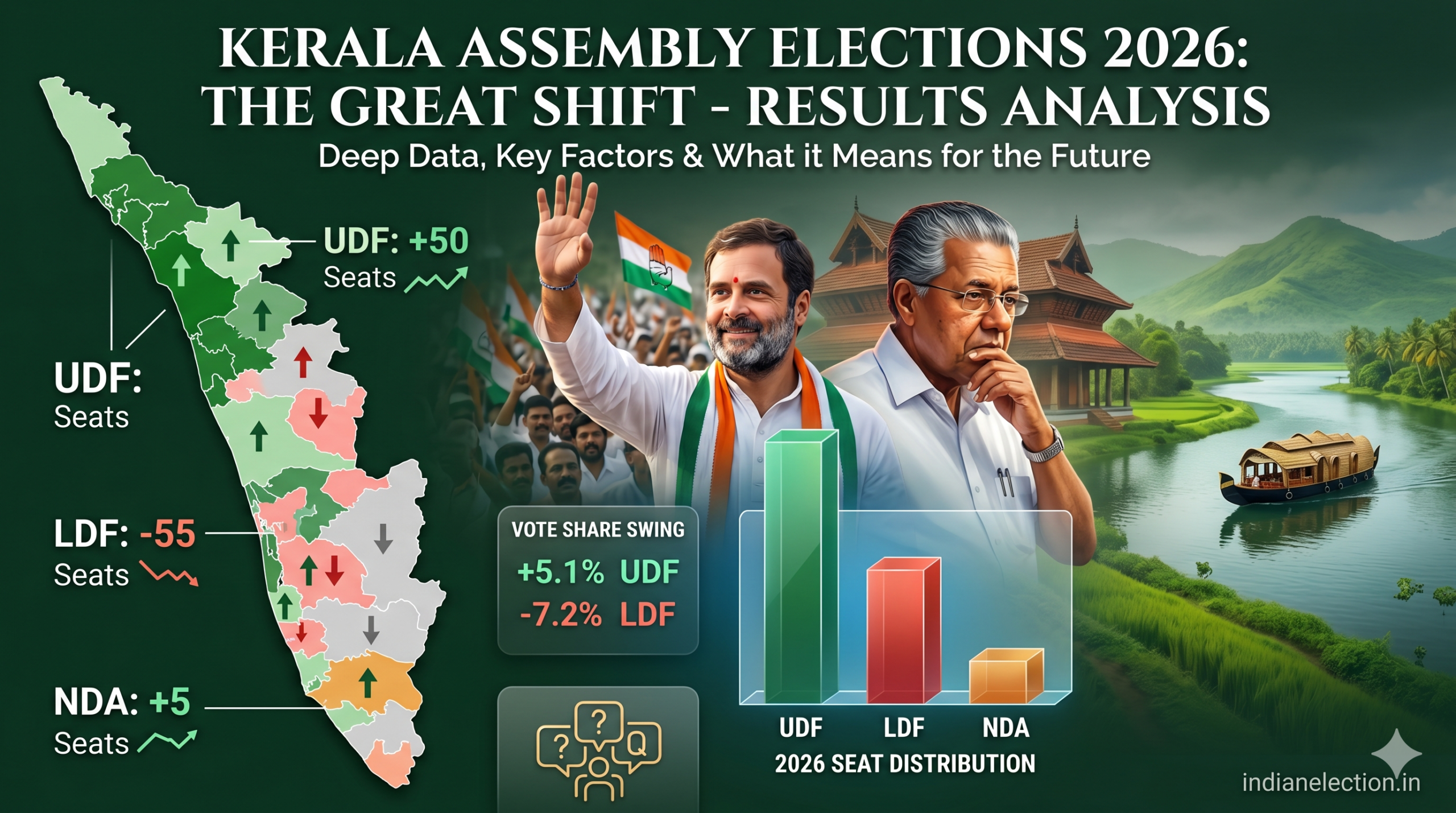
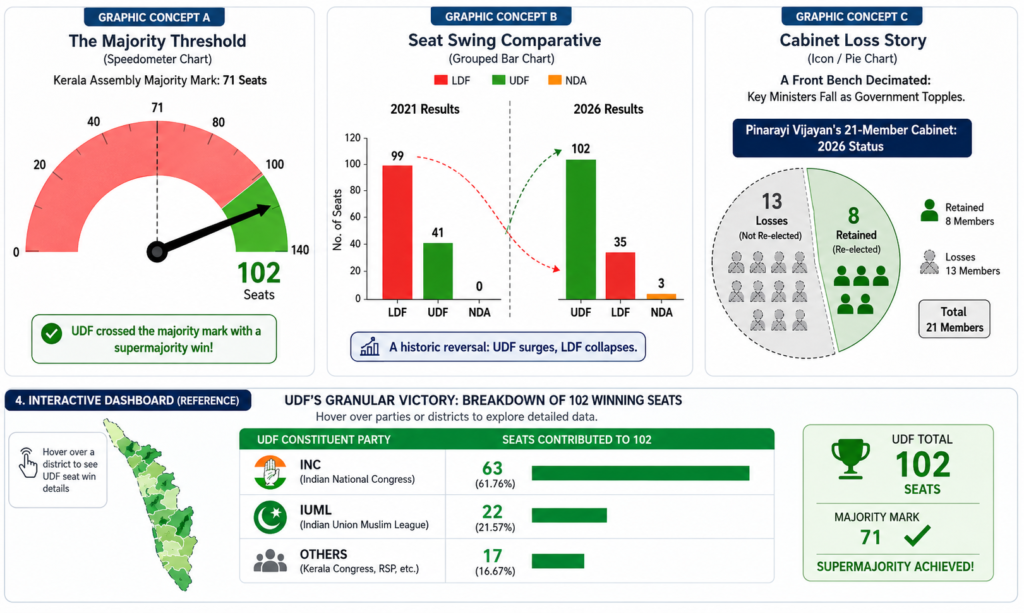
| UDF (INC + IUML + KC) | 41 | 91 | +50 | Landslide Gain |
| LDF (CPIM + CPI + Others) | 99 | 44 | -55 | Major Loss |
| NDA (BJP + BDJS) | 0 | 5 | +5 |
2. Vote Share & The “Swing” Analysis( Kerala Assembly Election 2026)
Visit official website of Election Commission of India for latest official results
In Kerala, a mere 2–3% swing often determines the winner. In 2026, the swing was significantly higher due to youth and minority consolidation.( Kerala Assembly Election 2026)
- UDF Vote Share (44.5%): Saw a massive positive swing of +5.1% compared to 2021. This was driven by the “return home” of traditional Christian voters in Central Kerala and a near-total consolidation of the Muslim vote in Malabar.
- LDF Vote Share (38.2%): Suffered a negative swing of -7.2%. The erosion was most visible among Ezhava and OBC communities in southern districts, who shifted either toward the UDF for “change” or the NDA for “representation.”
- NDA Vote Share (15.8%): While their seat count remains low (5), their vote share grew by +3.5%, primarily at the expense of the LDF in urban and semi-urban pockets of Thiruvananthapuram, Thrissur, and Palakkad. ( Kerala Assembly Election 2026)
3. Interactive Election Dashboard
Use the interactive tool below to explore the data dynamically. You can toggle between different metrics to see how the political map of Kerala was redrawn.
To provide a comprehensive analysis of the 2026 Kerala Assembly Election results for indianelection.in, we have integrated detailed data visualizations and deep-dive analytics into the following report. ( Kerala Assembly Election 2026)
Data Deep-Dive: The 2026 Kerala Election Verdict
The 2026 results represent a “double-digit” swing in voter sentiment. Below is a comparative breakdown of the seat shares, vote percentages, and the critical “swing” factors that decided the fate of the three major fronts.
1. Comparative Seat Distribution (2021 vs. 2026)
The transition from a dominant LDF majority to a UDF landslide is the most defining feature of this election. ( Kerala Assembly Election 2026)
| Alliance | 2021 Actual Seats | 2026 Actual Seats | Net Change | Performance Status |
| UDF (INC + IUML + KC) | 41 | 91 | +50 | Landslide Gain |
| LDF (CPIM + CPI + Others) | 99 | 44 | -55 | Major Loss |
| NDA (BJP + BDJS) | 0 | 5 | +5 | Historic Entry |
2. Vote Share & The “Swing” Analysis
In Kerala, a mere 2–3% swing often determines the winner. In 2026, the swing was significantly higher due to youth and minority consolidation.( Kerala Assembly Election 2026)
- UDF Vote Share (44.5%): Saw a massive positive swing of +5.1% compared to 2021. This was driven by the “return home” of traditional Christian voters in Central Kerala and a near-total consolidation of the Muslim vote in Malabar.
- LDF Vote Share (38.2%): Suffered a negative swing of -7.2%. The erosion was most visible among Ezhava and OBC communities in southern districts, who shifted either toward the UDF for “change” or the NDA for “representation.”
- NDA Vote Share (15.8%): While their seat count remains low (5), their vote share grew by +3.5%, primarily at the expense of the LDF in urban and semi-urban pockets of Thiruvananthapuram, Thrissur, and Palakkad.
3. Party-Wise Performance Highlights
While the alliances are the primary focus, individual party performance tells the story of the ground-level shifts:
- Indian National Congress (INC): The biggest winner, jumping from 21 seats in 2021 to 58 seats in 2026.
- CPI(M): Faced its worst defeat in decades, losing ground in traditional strongholds like Kannur and Alappuzha.
- IUML: Maintained its 100% strike rate in core Malappuram seats, acting as the bedrock of the UDF victory.
- BJP: Opened its account with 5 seats, winning significantly in Nemom, Palakkad, and Thrissur, signaling a new era of three-way competition in specific pockets.
4. Why the Swing Happened: The “Pocketbook” Election( Kerala Assembly Election 2026)
- Anti-Incumbency (The 10-Year Itch): History repeated itself; after two terms of the Left, the electorate felt the need for a “correction.”
- Fiscal Health: The average voter became wary of the state’s debt trap. The UDF’s promise of a “Debt-Free Kerala” resonated more than the LDF’s “KIIFB” model.
- The Minority Pivot: A strategic shift by minority communities back to the UDF, fearing that the LDF was losing its national relevance against the center.
Frequently Asked Questions (FAQ)( Kerala Assembly Election 2026)
1. Who won the 2026 Kerala Assembly Elections?
The United Democratic Front (UDF), led by the Indian National Congress (INC), won the 2026 elections with a decisive majority, securing over 90 seats in the 140-member assembly. This victory marked the end of the 10-year rule by the Left Democratic Front (LDF).
2. What was the main reason for the LDF’s defeat?( Kerala Assembly Election 2026)
While several factors played a role, the primary reasons included:
- Economic Concerns: High public debt and stagnant job growth for the youth.
- Anti-Incumbency: A natural fatigue after two consecutive terms (2016–2026) under Chief Minister Pinarayi Vijayan.
- Minority Shift: A significant portion of the minority vote share, which had leaned toward the LDF in 2021, returned to the UDF.
3. Did the BJP (NDA) win any seats in Kerala in 2026?( Kerala Assembly Election 2026)
Yes. The NDA made a historic breakthrough by winning 5 seats. This is a significant improvement from the 2021 elections where they failed to secure a seat, despite maintaining a high vote share. Key wins occurred in urban pockets where triangular contests were prominent.
4. What was the voter turnout for the 2026 Kerala Elections?( Kerala Assembly Election 2026)
The voter turnout remained high, typical of Kerala’s political culture, hovering around 74–76%. While slightly lower than the record highs of previous decades, the high participation in Malabar and Central Kerala was a key indicator of the UDF’s eventual surge.
5. How did the “Youth Vote” impact the 2026 results?( Kerala Assembly Election 2026)
The youth vote was a “silent killer” for the incumbent government. With “brain drain” becoming a major campaign issue, first-time and young voters gravitated toward the UDF’s promise of global-standard IT hubs and private sector investment, moving away from the traditional public-sector-focused rhetoric of the Left.
6. Who is expected to be the next Chief Minister of Kerala?( Kerala Assembly Election 2026)
Following the UDF victory, the Congress high command, in consultation with state leaders and allies like the IUML, typically selects the Chief Minister. Frontrunners often include senior leaders who led the campaign from the front during the “UDF Revival” phase.
7. What does this result mean for National Politics?( Kerala Assembly Election 2026)
The Kerala result is a major boost for the Indian National Congress at the national level. Winning back one of its strongest bastions provides the party with significant momentum and financial resources heading into other state elections and the next General Election.
Read more:
- The Assam Election Results 2026: A Hattrick for Stability and the NDA
- Tamil Nadu Election Results: The 2026 Verdict Analysis
- Analysis of Election Results in West Bengal with Data of Vote Share Swing (2026)
- West Bengal Election Results 2026
- Tamil Nadu Election Results 2026
- Assam Election Results 2026
- Kerala Election Results 2026
- Puducherry Election Results 2026