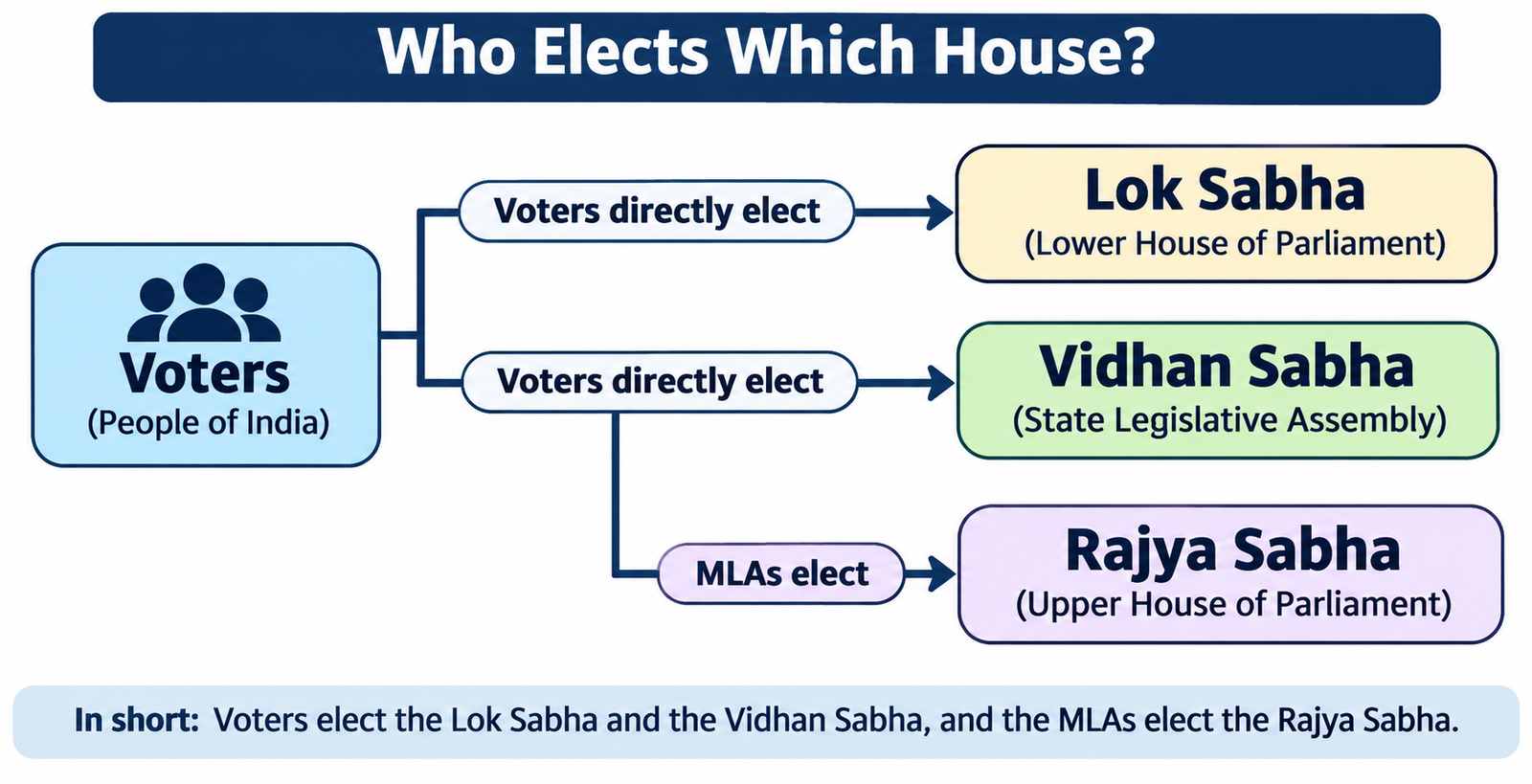
Lok Sabha vs Rajya Sabha vs Vidhan Sabha. Every few years you vote for an MP, and every few years you vote for an MLA. News reports talk about bills being passed in the Lok Sabha and “stuck” in the Rajya Sabha, while your state government works in the Vidhan Sabha. It is easy to mix them up.
This guide explains the three bodies in plain language: who is in each one, who elects them, how long they serve, and what powers they have. A comparison table is included, so you can see the differences at a glance.
The quick answer
- Lok Sabha is the lower house of Parliament. Its members (MPs) are elected directly by voters. It decides who runs the central government.
- Rajya Sabha is the upper house of Parliament. Its members (also MPs) are mostly elected by the MLAs of each state, not by the public directly. It is a permanent house that never dissolves.
- Vidhan Sabha is the lower house of a state’s legislature. Its members (MLAs) are elected directly by voters. It decides who runs the state government.
First, how the pieces fit together
India has a federal system, with a government at the centre (the Union) and one in each state.
- Parliament makes laws for the whole country. It has the President and two houses, the Lok Sabha and the Rajya Sabha.
- A State Legislature makes laws for one state. In every state it includes the Governor and the Vidhan Sabha (Legislative Assembly). A few states also have a second house, the Vidhan Parishad (Legislative Council).
The Constitution divides subjects between them. Parliament makes laws on the Union List (such as defence and foreign affairs), state legislatures on the State List (such as police and public health), and both on the Concurrent List (such as education). On a Concurrent List subject, if a central law and a state law conflict, the central law generally prevails.
What is the Lok Sabha?
The Lok Sabha is called the House of the People, because its members are chosen directly by the people.
- Size: The Constitution allows a maximum of 550 members, of whom 530 can represent states and 20 can represent union territories. At present the Lok Sabha has 543 elected members. See our table of Lok Sabha seats by state to see how these seats are shared.
- Who elects them: Every voter aged 18 or above in a constituency votes directly for one candidate. The candidate with the most votes wins (the first-past-the-post system). For the polling-day experience, see our guide to the voting process in India.
- Term: Five years, unless the House is dissolved earlier.
- Minimum age to contest: 25 years.
- Presiding officer: The Speaker, who is chosen by the members.
- Why it matters most: The leader who commands a majority in the Lok Sabha becomes Prime Minister. The Council of Ministers is collectively responsible to this house. That means the government can fall if it loses the support of the Lok Sabha, for example through a no-confidence motion.
- Lok Sabha Seats by State
One more thing to know: the number of Lok Sabha seats given to each state is based on the 1971 census, and a constitutional amendment froze it until the first census after 2026. Any change to seat numbers would follow a new census and delimitation exercise.
What is the Rajya Sabha?
The Rajya Sabha is called the Council of States. It represents the states and union territories in Parliament.
- Size: The Constitution allows a maximum of 250 members. At present the strength is 245: 233 represent states and union territories (Delhi and Puducherry have members too), and 12 are nominated by the President for their expertise in fields such as literature, science, art and social service.
- Who elects them: Members from each state are elected by that state’s MLAs, using the single transferable vote system. So voters choose MLAs, and MLAs choose Rajya Sabha members. This is why the Rajya Sabha is called an indirectly elected house.
- Term: Six years. But the house never dissolves. Instead, one-third of its members retire every two years, and new members are elected in their place.
- Minimum age: 30 years.
- Presiding officer: The Chairman, who is the Vice-President of India.
The Rajya Sabha reviews bills sent by the Lok Sabha and can suggest changes. It also has a few special powers. For example, it can authorise Parliament to make laws on a State List subject in the national interest, if two-thirds of its members present and voting agree.
What is the Vidhan Sabha?
The Vidhan Sabha is the Legislative Assembly of a state (or of a union territory with a legislature, such as Delhi and Puducherry). Its members are called MLAs, or Members of the Legislative Assembly.
- Size: Between 60 and 500 members, depending on the state’s population. Parliament has allowed smaller assemblies in some small states such as Goa, Sikkim and Mizoram.
- Who elects them: Voters elect them directly from single-member constituencies, the same way as the Lok Sabha.
- Term: Five years, unless dissolved earlier.
- Minimum age to contest: 25 years.
- Presiding officer: The Speaker.
- Why it matters: The party or alliance with a majority in the Vidhan Sabha forms the state government, and its leader becomes Chief Minister.
Some states have a second house, the Vidhan Parishad (Legislative Council). It has advisory powers and is indirectly elected. It exists in only a few states. [Check the current list of states with a Legislative Council on the Government of India or Election Commission website.
Comparison table: Lok Sabha vs Rajya Sabha vs Vidhan Sabha
| Lok Sabha | Rajya Sabha | Vidhan Sabha | |
|---|---|---|---|
| Full name | House of the People | Council of States | State Legislative Assembly |
| Level | Centre (Parliament) | Centre (Parliament) | State |
| Members called | MPs | MPs | MLAs |
| Current strength | 543 elected | 245 (233 elected, 12 nominated) | 60 to 500 per state (smaller in some states) |
| Who elects them | Voters directly | State MLAs (single transferable vote) | Voters directly |
| Term | 5 years | 6 years, one-third retire every 2 years | 5 years |
| Can it be dissolved? | Yes | No, it is permanent | Yes |
| Minimum age | 25 | 30 | 25 |
| Presiding officer | Speaker | Chairman (Vice-President) | Speaker |
| Who forms the government? | Majority here picks the Prime Minister | Does not decide this | Majority here picks the Chief Minister |
Key differences in powers
1. Money Bills. A Money Bill, which deals with taxes and government spending, can only start in the Lok Sabha. The Rajya Sabha can discuss it and suggest changes within a time limit, but the Lok Sabha can accept or reject them. In practice, the Lok Sabha has the final say on money matters.
2. Confidence in the government. Only the Lok Sabha can pass a no-confidence motion against the Council of Ministers. The Rajya Sabha cannot remove the government.
3. Ordinary bills. An ordinary bill can start in either house and must be passed by both. If the two houses disagree, the Constitution provides for a joint sitting, where the larger Lok Sabha usually has the advantage.
4. Constitutional amendments. Most amendments need a special majority in both houses of Parliament, so the Rajya Sabha has real power here. Some amendments also need approval from half the state legislatures.
5. State legislation. A Vidhan Sabha makes laws on State List subjects and, along with Parliament, on the Concurrent List. It also passes the state budget.
6. Electing the President. The President is elected by an electoral college made up of the elected members of both houses of Parliament and of all state legislative assemblies. The Vice-President is elected by members of both houses of Parliament.
Who runs these elections?
The Election Commission of India conducts elections to the Lok Sabha, the Rajya Sabha (indirectly, through the legislators who vote), the state assemblies and the offices of President and Vice-President. You can read more in our guide to the Election Commission of India. During an election, parties and governments must follow the Model Code of Conduct.
Frequently asked questions
Do I vote for the Rajya Sabha?
No. Rajya Sabha members are elected by state MLAs, not directly by voters. But your vote for an MLA decides who those electors are.
Which house is more powerful, the Lok Sabha or the Rajya Sabha?
In practice the Lok Sabha, because it controls money bills and the survival of the government. The Rajya Sabha has real influence on ordinary laws and constitutional amendments.
Can the Rajya Sabha be dissolved?
No. It is a continuing house. One-third of its members retire every two years.
Is an MLA the same as an MP?
No. An MLA sits in a state assembly (Vidhan Sabha). An MP sits in Parliament, in the Lok Sabha or the Rajya Sabha.
Who becomes Prime Minister?
The leader of the party or alliance that can command a majority in the Lok Sabha. The Prime Minister can also be a member of the Rajya Sabha, as has happened in the past.
How many voters choose an MP and an MLA?
The voters of a Lok Sabha constituency are far more numerous than those of an assembly constituency, because each Lok Sabha seat usually covers several assembly segments.
Can I vote if my name is not on the roll?
No. Check your name early. Our Voter Services page shows how to check the roll and apply with Form 6.
The short version
The Lok Sabha is the House of the People, with 543 directly elected MPs who decide who runs the country. The Rajya Sabha is the Council of States, with 245 members who are mostly elected by state MLAs and who serve staggered six-year terms. The Vidhan Sabha is the state assembly, with MLAs directly elected by voters, deciding who runs the state. Three bodies, three levels of power, and your vote shapes two of them directly.
Sources to cite (open each page, confirm the point, then link it in your post):
- Government of India portal, Members of Parliament (Lok Sabha maximum 550, now 543): https://www.india.gov.in
- MoSPI Statistical Year Book, chapter on elections and legislature: https://mospi.gov.in/sites/default/files/Statistical_year_book_india_chapters/Chapter%20No.%2043.pdf
- Constitution of India (Articles 79 to 122 and 168 to 212): https://www.indiacode.nic.in
- Parliament of India: https://sansad.in
- indiacode.nic.in
Written by Mahboob Ali. Last reviewed: November 2026. This site is independent and not connected with the Election Commission of India. Rules and procedures can change, so confirm details on the official portals.