Voting Process in India. The first time I thought about voting, the part that worried me was not choosing a candidate. It was the walk into the polling station. Where do I stand? What will they ask me? What if I press the wrong thing?
If you have the same worries, this guide is for you. It walks through the whole voting process in India, in the order things happen on polling day, and explains what each person at the booth is doing and why.
Before polling day: three things to sort out
Most problems on polling day can be avoided in the week before.
1. Check that your name is on the electoral roll. You can only vote if your name is on the roll for your polling area. Having a voter ID card is not enough on its own. Search your name at electoralsearch.eci.gov.in or in the Voter Helpline app. If it is missing, our guide to Voter Services explains how to apply with Form 6. Do this early, because late applications may not be added in time.
2. Find your polling station. The same search tells you your part number and your polling station. Polling stations are usually schools, community halls or government buildings close to where you live. Go and look at the route once if you can.
How to Find Your Polling Booth Near Me
3. Keep your photo ID ready. The Election Commission asks voters to carry their EPIC (the voter ID card, or the e-EPIC on your phone). If you do not have it, you can use one of the alternative photo documents the Commission accepts, such as Aadhaar, passport, driving licence or PAN card, as long as your name is on the roll. The list is longer than most people expect, and it can change, so check the current list on eci.gov.in before you leave home.
You will probably also get a Voter Information Slip from your Booth Level Officer before polling day. It shows your name, part number and polling station. It is a useful guide, but it is not valid as photo ID. You still need to carry your ID.
On polling day: what happens, step by step
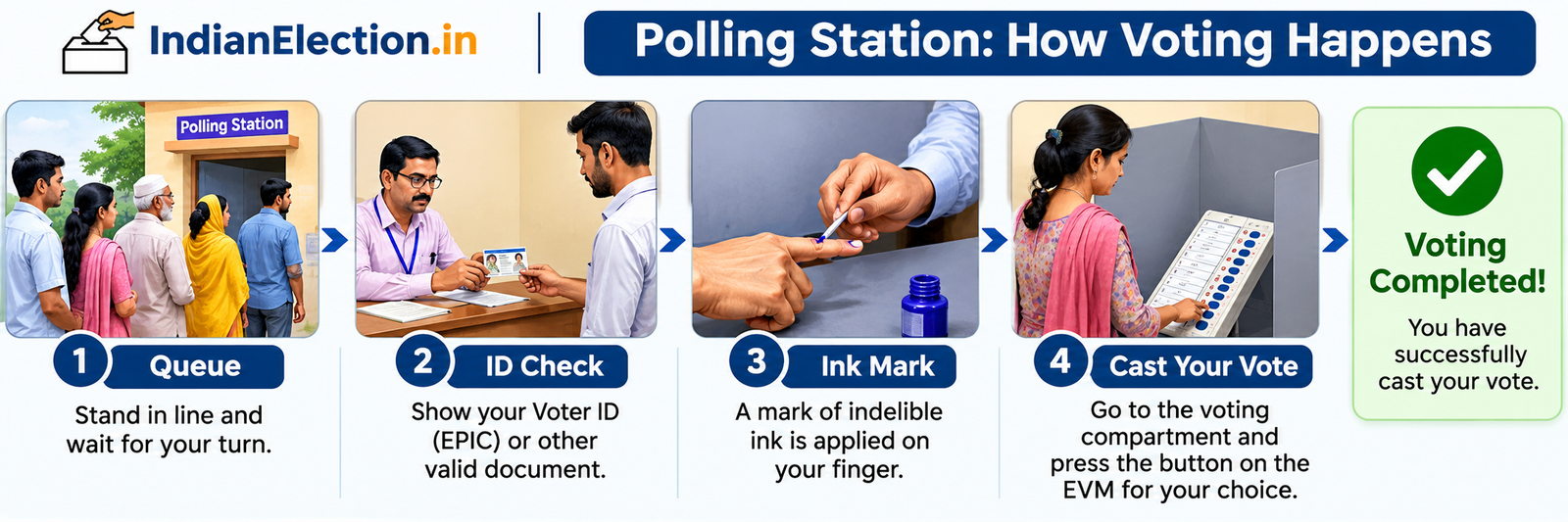
Step 1: Reach the polling station and join the queue
Polling usually runs from morning to early evening. The exact hours can differ by area and by election, so check the timing printed on your slip or on the Commission’s website. If you can, go earlier in the day. Queues are often shortest in the first hours and again late in the afternoon.
Many polling stations give priority to senior citizens, persons with disabilities and sometimes pregnant women or mothers with babies. If this applies to you or someone with you, ask the staff or volunteers at the gate.
Two small rules to remember at the entrance. Campaigning is not allowed near the polling station, so you will not see party workers handing out leaflets right at the gate. And phones are restricted inside the voting area, so keep yours switched off or silent, and never photograph the ballot unit. The secrecy of your vote is protected by law.
How to Correct Details in Voter ID Online (Name, Address, Age)
Step 2: Your name and ID are checked
When you reach the first polling officer, they will find your name on the printed electoral roll and check your photo ID against it. This is the moment where a missing or wrong name causes problems, which is why the pre-election check matters. Have your ID in your hand, not at the bottom of a bag.
Step 3: The ink mark and your signature
The second polling officer marks your left forefinger with indelible ink, and notes your entry in the register of voters. You will be asked to sign, or give a thumb impression, and you may be given a slip.
The ink is not just a tradition. It stops anyone from voting twice in the same election. It is made in Mysuru and has been used in Indian elections for decades. If you have no left forefinger, the officer marks another finger.
Step 4: The control unit is cleared for your vote
A third polling officer checks the ink mark and takes your slip. They then press a button on the Control Unit of the EVM. This releases the machine so that one vote can be recorded. Nobody else can see or choose your vote at this stage.
Step 5: Voting inside the compartment
You go behind a screen into a small voting compartment. On the Ballot Unit you will see the names of candidates, their party symbols, and, at the bottom of the list, the NOTA option (“None of the Above”). Next to each name is a blue button.
Press the blue button next to the candidate you want. Press it once, firmly. A red light glows next to your choice and you hear a long beep. That beep tells you the vote has been recorded.
Step 6: Check the VVPAT slip
Next to the ballot unit is a transparent window on a machine called the VVPAT. For about seven seconds, a printed slip appears there showing the serial number, name and symbol of the candidate you voted for. Check it. Then the slip drops into a sealed box. You do not take it home.
If you want to read more about how the machines work together, see our explainer on how EVMs work in India.
Step 7: Leave quietly
Walk out of the polling station. Do not announce your vote or take photographs inside. Your finger will carry the ink mark for a few weeks, so you can show it if someone asks.
How to Apply for New Voter ID Online in India (Step-by-Step Guide)
What if something goes wrong?
My name is not on the roll. Without a name on the roll you cannot vote, even with a valid ID. Ask the presiding officer to check, note the part number from your slip, and call the Voter Helpline on 1950 for guidance. After the election, apply for a correction or new registration.
Someone has already voted in my name. Tell the presiding officer immediately. Under the rules, a genuine voter in this situation can ask to cast a tendered vote on a paper ballot after proving their identity. It is a rare situation, so ask the officer to explain the exact procedure.
I am in the queue when polling time ends. Voters who are already in the queue when the time ends are generally allowed to vote, so do not leave.
The machine did not beep, or I am unsure my vote was recorded. Do not leave the compartment. Call the polling officer and explain what happened.
I think someone is breaking the rules. Report it to the presiding officer, or to the Commission using the c-VIGIL app or the helpline 1950 or National Grievance Services Portal
.Visit official website for more details: https://www.eci.gov.in/
What to carry, in one list
- EPIC (voter ID) or e-EPIC, or another accepted photo ID
- Your Voter Information Slip, if you received one
- Water and a cap or umbrella if it is hot or raining, since queues can be long
- Nothing else. Leave bags, banners and party items at home
Frequently asked questions
Is voting compulsory in India?
No. Voting is a right and a civic duty, but it is not compulsory at the national level.
Can I vote without a voter ID card?
Yes, if your name is on the electoral roll and you carry one of the other photo ID documents accepted by the Election Commission.
Can I vote if I am in a different city on polling day?
You vote at the polling station where you are registered. If you have moved permanently, update your address using Form 8 well before the election.
Can I use my phone on polling day?
You can use it to check your polling station and roll entry before you enter. Inside the voting area, phones are restricted and you must not photograph your vote.
Who can I call for help?
The Voter Helpline, 1950, or the Voter Helpline app.
The short version
Check your name early, know your polling station, carry your photo ID, and press the blue button once. Then wait for the beep and look at the VVPAT slip. That is the whole process, and for most voters it takes only a few minutes.
Official sources:
- Election Commission of India: https://eci.gov.in
- Voter Services Portal and electoral search: https://voters.eci.gov.in and https://electoralsearch.eci.gov.in
- Voter Helpline: 1950
Written by Mahboob Ali. Last reviewed: 12 November 2026. This site is independent and not connected with the Election Commission of India. Rules and procedures can change, so confirm details on the official portal.
4 thoughts on “Voting Process in India: What Happens at the Polling Station, Step by Step”