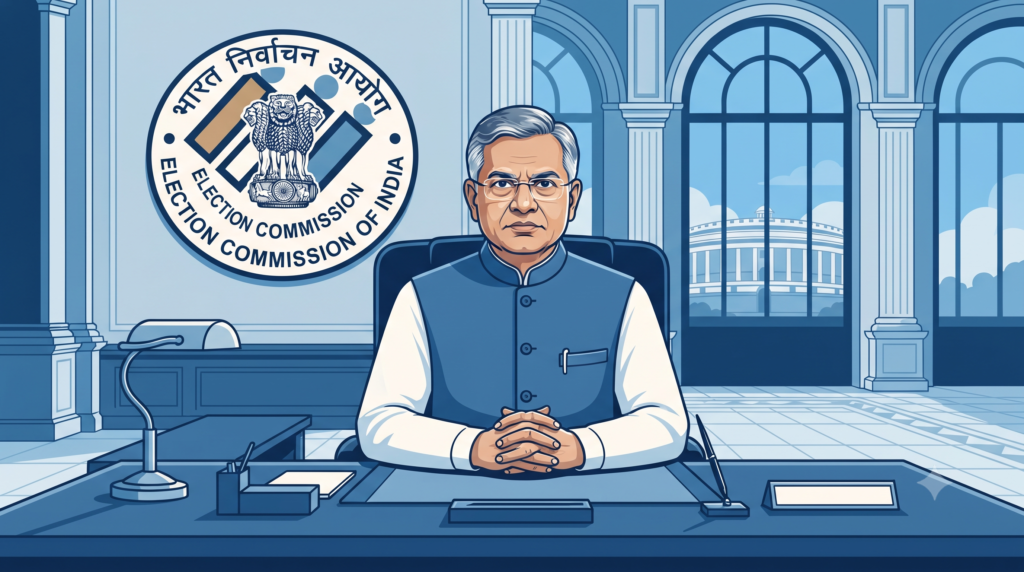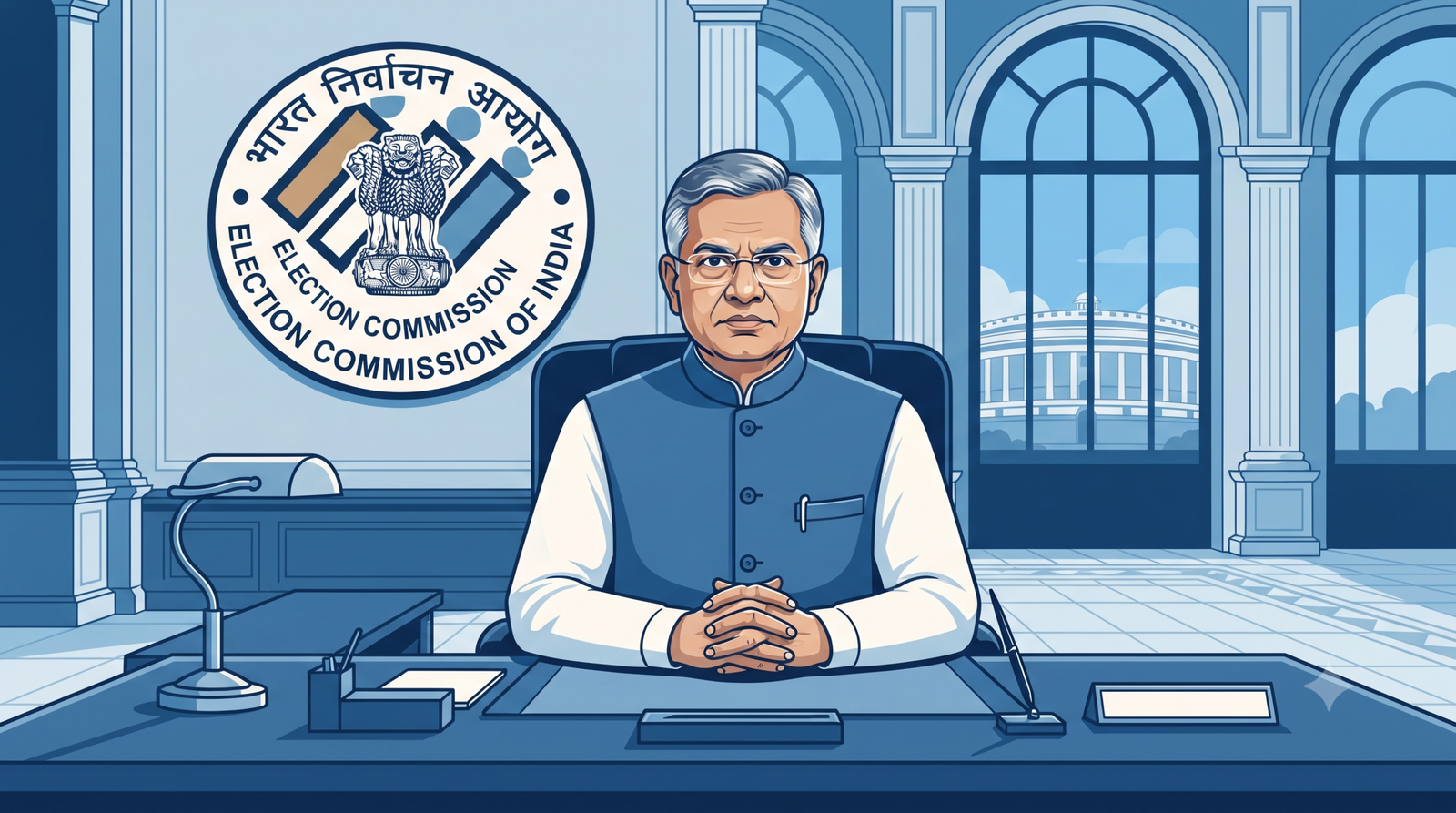
In February 2025, a single appointment sent shockwaves through India’s political corridors. Gyanesh Kumar — a retired IAS officer from the 1988 Kerala cadre — was named India’s 26th Chief Election Commissioner (CEC), the most powerful electoral authority in the world’s largest democracy.
But this wasn’t a routine appointment. It came loaded with opposition dissent, a Supreme Court challenge, a first-ever parliamentary removal notice, and fierce debate about India’s electoral independence. Since then, CEC Gyanesh Kumar has remained at the centre of one of the most politically charged controversies in recent Indian electoral history.
In this comprehensive explainer, we break down everything you need to know — who Gyanesh Kumar is, how he was appointed, why the opposition wants him removed, what charges have been levelled, and what it all means for India’s upcoming elections.
Who Is Gyanesh Kumar?
Gyanesh Kumar is a retired Indian Administrative Service (IAS) officer from the 1988 batch of the Kerala cadre. He is widely regarded as a senior bureaucrat with deep experience in sensitive government portfolios.
Key Facts About Gyanesh Kumar:
- Batch: IAS 1988, Kerala Cadre
- Education: Alumni of Harvard University
- Previous Role: Senior positions in the Union Home Ministry
- Notable Contribution: Played a key role in implementing decisions following the abrogation of Article 370 in Jammu & Kashmir during his stint in the Home Ministry
- Joined ECI: March 15, 2024 (as Election Commissioner)
- Appointed CEC: February 18, 2025
- Tenure as CEC: Until January 26, 2029
- Designation: 26th Chief Election Commissioner of India
Kumar is the senior-most Election Commissioner at the time of his appointment, with the other commissioner being S.S. Sandhu, also appointed in March 2024.
How Was Gyanesh Kumar Appointed? The New Law Controversy
This is where the story gets constitutionally significant. Gyanesh Kumar is the first CEC to be appointed under the new Chief Election Commissioner and Other Election Commissioners (Appointment, Conditions of Service and Term of Office) Act, 2023 — a law that fundamentally changed how India’s top electoral official is selected.
What Changed Under the 2023 Act?
Before 2023, the President of India appointed the CEC on the recommendation of the Prime Minister — a process widely considered to lack adequate checks and balances.
In March 2023, the Supreme Court of India stepped in with a landmark ruling, directing that the CEC and Election Commissioners be selected by a three-member committee comprising:
- The Prime Minister
- The Leader of the Opposition (LoP)
- The Chief Justice of India (CJI)
The inclusion of the CJI was seen as a crucial check to keep the appointment process independent of executive control.
However, before this ruling could be implemented, the government passed the new 2023 Act — which replaced the Chief Justice of India with a Union Cabinet Minister nominated by the Prime Minister. This gave the executive a 2-1 majority in the selection committee, effectively allowing the ruling government to decide the CEC appointment with ease.
Who Was on the Selection Committee for Gyanesh Kumar?
- Prime Minister Narendra Modi
- Home Minister Amit Shah (as the nominated Cabinet Minister)
- Leader of Opposition Rahul Gandhi
The committee went ahead with Gyanesh Kumar’s appointment — overriding a formal dissent note submitted by Rahul Gandhi, who opposed both the appointment and the selection process itself.
Rahul Gandhi’s Objection: “The committee is flawed itself as the government has a majority in it with two representatives. With this pattern, a fair decision in appointing the CEC is not possible.”
The Supreme Court Challenge
The controversy didn’t stop at political dissent. The Association for Democratic Reforms (ADR) — a prominent electoral watchdog — petitioned the Supreme Court against the new appointment process.
The Supreme Court agreed to hear the case on February 19, 2025 — just one day after outgoing CEC Rajiv Kumar’s retirement — marking it as a priority matter. The central legal question before the court: Can Parliament override a Constitution Bench judgment through legislation?
This remains one of the most consequential constitutional questions in India’s recent legal history, with implications for the independence of all constitutional bodies.
What Elections Will Gyanesh Kumar Oversee?
As CEC until January 26, 2029, Gyanesh Kumar is set to preside over some of the most important elections in India’s democratic calendar:
| Election | Year | Significance |
|---|---|---|
| Bihar Assembly Elections | 2025 | First major state poll under his watch |
| Kerala Assembly Elections | 2026 | Kumar’s home state cadre |
| Tamil Nadu Assembly Elections | 2026 | High-stakes southern state poll |
| West Bengal Assembly Elections | 2026 | Politically sensitive, TMC stronghold |
| Puducherry Assembly Elections | 2026 | Union territory poll |
| Presidential Election | 2027 | Oversees electoral college voting |
| Vice-Presidential Election | 2027 | Constitutional election oversight |
| Lok Sabha General Elections | 2029 | The biggest election on earth |
In total, Gyanesh Kumar is expected to oversee at least 22 Assembly elections during his tenure as CEC — making him one of the most consequential holders of the office in recent decades.
The Removal Controversy: A First in Indian History
In March 2026, something unprecedented in Indian democratic history happened — the opposition filed formal notices in both Houses of Parliament seeking the removal of a sitting Chief Election Commissioner.
Timeline of the Removal Notices:
📅 March 12, 2026 — First Removal Notice
- 130 Lok Sabha MPs signed a notice submitted to the Lok Sabha Speaker
- 63 Rajya Sabha MPs signed a notice submitted to the Rajya Sabha Chairman
- The basis: Article 324(5) of the Constitution, which states the CEC can only be removed in the same manner as a Supreme Court judge — on grounds of “proved misbehaviour” or incapacity
📅 April 6-7, 2026 — Notices Rejected
- Lok Sabha Speaker Om Birla rejected the Lok Sabha notice
- Rajya Sabha Chairman C.P. Radhakrishnan rejected the Rajya Sabha notice
- Reason given: Even if the allegations were assumed to be true, they did not meet the high constitutional threshold of “misbehaviour” required for removal proceedings
📅 April 24, 2026 — Fresh Notice Filed
- Opposition parties submitted a fresh notice in the Rajya Sabha with 73 Opposition MPs signing it (requirement: 50 signatures)
- Led by Congress leader Jairam Ramesh and TMC leader Sagarika Ghose
- Congress stated there are now nine specific charges against the CEC recorded in “extreme detail”
What Are the Charges Against CEC Gyanesh Kumar?
The opposition has levelled several serious allegations against the Chief Election Commissioner. Here is a factual summary of the key charges:
1. Partisan Enforcement of the Model Code of Conduct (MCC)
The most prominent charge is “continued partisan asymmetry in the enforcement of the Model Code of Conduct”. The opposition accused the Election Commission of failing to act on complaints regarding Prime Minister Narendra Modi’s address to the nation on April 18, 2026 — which occurred ahead of the Assembly elections in West Bengal and Tamil Nadu, allegedly in violation of the MCC.
2. Actions and Omissions from March 15, 2026
The removal notice specifically cites actions and errors committed on March 15, 2026 and thereafter as constituting “proved misbehaviour” under Article 324(5) of the Constitution, read with Article 124(4).
3. Bias in Electoral Administration
Multiple opposition parties — Congress, TMC, Samajwadi Party, DMK — have alleged that the Election Commission under Gyanesh Kumar has demonstrated selective inaction on complaints against the ruling party while acting swiftly against opposition parties.
4. The TMC Delegation Incident
In April 2026, a TMC delegation’s meeting with the Election Commission turned confrontational, with TMC leader Derek O’Brien allegedly shouting at the CEC during a heated exchange — reflecting the depth of tension between the opposition and the election body.
Important Note: The Lok Sabha Speaker and Rajya Sabha Chairman both rejected the removal notices, ruling that the allegations do not meet the constitutional bar for CEC removal. The charges represent the opposition’s political position, not established judicial findings.
Why Is the CEC’s Independence So Important for Indian Democracy?
The Chief Election Commissioner is not just another government official. The CEC is a constitutional authority who operates independently of the government — or is supposed to.
Why the CEC Matters:
- The CEC oversees free and fair elections for over 970 million registered voters in India
- The CEC enforces the Model Code of Conduct — the rulebook that constrains all political parties and the government during election season
- The CEC has the authority to transfer officers, postpone elections, and act against electoral malpractice
- The CEC’s decisions directly determine whether India’s elections are seen as legitimate by its citizens and the international community
When the independence of the CEC is questioned — whether fairly or as political strategy — it erodes public confidence in the electoral process itself. This is why the current controversy carries stakes far beyond a single appointment.
The Bigger Picture: Is India’s Election Commission Truly Independent?
The Gyanesh Kumar controversy has reignited a decades-old debate: Is the Election Commission of India truly independent of the executive?
Arguments That Independence Is Compromised:
- The 2023 Act removed the Chief Justice from the selection committee, giving the government a 2-1 majority in appointments
- Opposition alleges partisan MCC enforcement
- ADR’s Supreme Court petition questions the constitutional validity of the new appointment process
Arguments That Independence Remains Intact:
- The CEC holds a constitutionally protected tenure and can only be removed like a Supreme Court judge
- The Lok Sabha Speaker and Rajya Sabha Chairman — from different political backgrounds — both independently rejected the removal notices
- The ECI has continued to conduct elections with broad logistical success
- The Supreme Court continues to monitor the constitutional validity of the new appointment law
What Happens Next?
As of mid-2026, here is the status of the key developments:
- The opposition’s fresh Rajya Sabha notice (April 2026) with 73 MP signatures is pending consideration
- The opposition is reportedly aiming to gather 200+ MP signatures for a stronger attempt
- The Supreme Court case on the constitutional validity of the 2023 appointment law remains pending
- Gyanesh Kumar continues as CEC and is overseeing the upcoming Bihar and state elections in 2025-26
- His tenure runs until January 26, 2029 — days before the next Lok Sabha election is expected to be announced
Quick Summary
| Key Point | Detail |
|---|---|
| Full Name | Gyanesh Kumar |
| Designation | 26th Chief Election Commissioner of India |
| Appointed On | February 18, 2025 |
| Tenure Ends | January 26, 2029 |
| IAS Batch | 1988, Kerala Cadre |
| First CEC under new 2023 law? | ✅ Yes |
| Removal notices filed? | ✅ Yes — March 2026 (rejected) & April 2026 (pending) |
| Supreme Court challenge? | ✅ Yes — on appointment process validity |
| Elections he will oversee | 22+ state polls + 2029 Lok Sabha |
Frequently Asked Questions (FAQs)
Q1. Who is Gyanesh Kumar?
Gyanesh Kumar is a retired IAS officer from the 1988 batch of the Kerala cadre. He was appointed as India’s 26th Chief Election Commissioner on February 18, 2025, succeeding Rajiv Kumar. He is also a Harvard University alumnus and previously served in the Union Home Ministry where he played a key role in implementing decisions related to the abrogation of Article 370 in Jammu & Kashmir.
Q2. How was Gyanesh Kumar appointed as CEC?
He was appointed under the new Chief Election Commissioner and Other Election Commissioners (Appointment, Conditions of Service and Term of Office) Act, 2023. The selection committee comprised Prime Minister Narendra Modi, Home Minister Amit Shah, and Leader of Opposition Rahul Gandhi — who submitted a dissent note opposing the appointment.
Q3. Why is the appointment of Gyanesh Kumar controversial?
The controversy stems from the 2023 law that replaced the Chief Justice of India with a Cabinet Minister in the CEC selection committee, giving the ruling government a 2-1 majority. The Supreme Court had previously directed the CJI’s inclusion to ensure independence. The opposition and civil society groups argue this gives the executive disproportionate control over who runs India’s elections.
Q4. Has any removal notice ever been filed against a CEC before?
No. The March 2026 removal notice filed against Gyanesh Kumar by 130 Lok Sabha MPs and 63 Rajya Sabha MPs was the first such attempt in Indian history to initiate removal proceedings against a sitting Chief Election Commissioner.
Q5. What were the charges against CEC Gyanesh Kumar?
The opposition alleged “proved misbehaviour” including partisan asymmetry in enforcing the Model Code of Conduct, failure to act on complaints against the ruling party, and specific actions and omissions from March 15, 2026 onwards. The Congress stated there are nine specific charges against the CEC recorded in extreme detail.
Q6. Were the removal notices against the CEC accepted?
No. Both the Lok Sabha Speaker Om Birla and Rajya Sabha Chairman C.P. Radhakrishnan rejected the March 2026 removal notices in April 2026, stating that even if the allegations were assumed to be true, they did not meet the high constitutional threshold of “misbehaviour” required to initiate CEC removal proceedings.
Q7. How can the Chief Election Commissioner be removed in India?
Under Article 324(5) of the Constitution, the CEC can only be removed in the same manner as a Supreme Court judge — by an address of both Houses of Parliament passed by a special majority, on grounds of “proved misbehaviour” or incapacity. This is an extremely high constitutional bar, designed to protect the CEC’s independence.
Q8. Until when will Gyanesh Kumar serve as CEC?
Gyanesh Kumar’s tenure as Chief Election Commissioner runs until January 26, 2029 — just days before the Election Commission is expected to announce the schedule for the next Lok Sabha general elections.
Q9. What major elections will Gyanesh Kumar oversee as CEC?
He is set to oversee Bihar Assembly elections (2025), Kerala, Tamil Nadu, West Bengal and Puducherry Assembly elections (2026), the Presidential and Vice-Presidential elections (2027), and at least 22 state assembly elections in total, culminating in the 2029 Lok Sabha General Elections.
Q10. What is the Supreme Court case about the CEC appointment?
The Association for Democratic Reforms (ADR) petitioned the Supreme Court challenging the constitutional validity of the 2023 Act that changed the CEC appointment process. The central question is whether Parliament can override a Constitution Bench judgment (which had mandated the CJI’s inclusion in the selection panel) through legislation. The case is pending before the Supreme Court.
Stay updated on all major Indian election news, voter services, electoral roll updates, and election results at indianelection.in — your trusted independent guide to Indian elections.