Indian elections : From “Stamp of Faith” to “Beep of Democracy”: The Evolution of Indian Elections
From ink-stained fingers and massive wooden boxes to the sleek EVMs we use today—discover how India transformed into the world’s largest digital democracy and why the “EVM vs. Ballot” debate still sets the nation on fire.
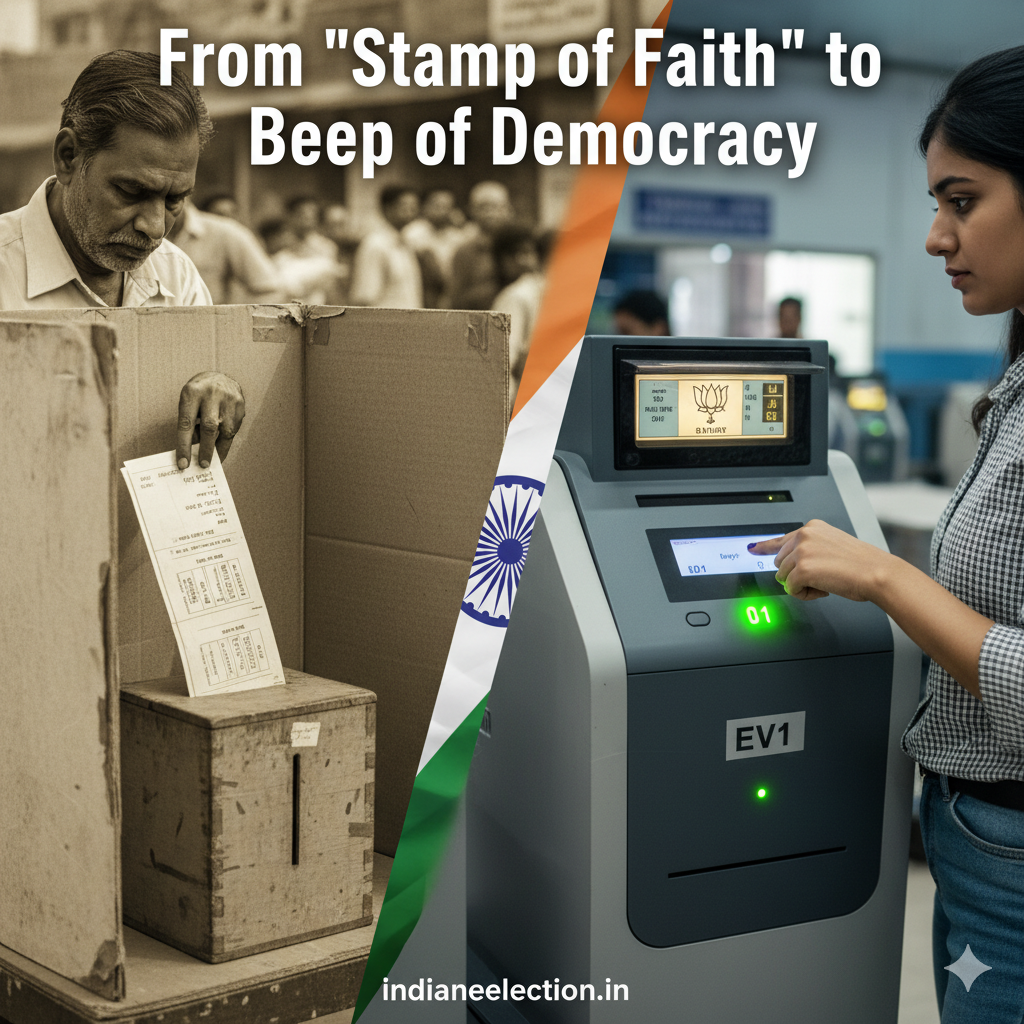
Remember the days of the big wooden boxes? In the early decades of our independence, voting was a messy, physical, and often dangerous affair. You’d get a long strip of paper, duck behind a cardboard screen, and use a rubber stamp to mark your choice. It felt personal, but it was far from perfect.
Today, as we stand at the polling booth, we hear that distinct beep of the Electronic Voting Machine (EVM). It takes seconds, but that sound represents decades of legal battles, technological innovation, and massive logistical shifts.
Here is how we got here.
The Era of the Ballot Paper (1951 – 1990s)
In India’s first two general elections (1951 and 1957), we used the “Balloting System.” Each candidate had their own separate box! If there were 10 candidates, you had to find the right box and drop your blank paper inside. Imagine the confusion!
By 1962, we moved to the “Marking System”—one paper for all candidates where you stamped your choice. While this was better, it led to “Booth Capturing.” Goons would physically take over a booth, stuff thousands of papers into the box, and flee. It was the “wild west” of democracy.
Enter the EVM: A Quiet Revolution
The idea for an electronic machine was born in 1977. It wasn’t just about speed; it was about security.
- 1982: First experimental use in Paravur, Kerala.
- 2004: The big milestone! India became the first major nation to conduct a General Election entirely through EVMs.
Why the change?
- No more “Invalid Votes”: On paper, if your stamp touched the line between two symbols, your vote was wasted. EVMs fixed that.
- Counting Speed: Paper counting took days; EVMs take hours.
- Curbing Fraud: An EVM only accepts 5 votes per minute. This makes “stuffing” a machine nearly impossible for a mob.
The Latest Shield: VVPAT
To answer the critics who asked, “How do I know my electronic vote went to the right person?”, the Election Commission introduced the VVPAT (Voter Verified Paper Audit Trail). Now, a tiny window shows you a printed slip of your choice for 7 seconds before it drops into a sealed box. It’s the perfect marriage of digital speed and physical proof.
❓ Frequently Asked Questions (FAQ)
Q1: Can an EVM be hacked via Bluetooth or Wi-Fi? A: No. Indian EVMs are “standalone” machines. They have no internet connection, no wireless communication chips (Bluetooth/Wi-Fi), and cannot be accessed remotely.
Q2: What happens if the power goes out during voting? A: EVMs do not run on wall sockets; they run on ordinary battery packs. A power cut in the polling station has zero impact on the machine’s functioning.
Q3: Can someone “re-program” the machine to favor a party? A: The software is “burnt” into a One-Time Programmable (OTP) chip during manufacturing. Once written, the code cannot be changed or rewritten.
Q4: How do I know the VVPAT paper matches my vote? A: After you press the button, the VVPAT printer glows and shows you the serial number, name, and symbol of your chosen candidate. You have 7 seconds to verify this before the slip falls into the secure box.
Q5: Why don’t developed countries like the US or Germany use EVMs? A: Every country has its own challenges. India’s transition was driven by the need to stop “booth capturing” and “invalid paper votes”—problems that were specific to our massive scale and past electoral history.
Vital Resources for Every Voter
If you want to dive deeper into how our system works or verify your own details, these are the only links you need:
- Official ECI Portal: Register as a new voter or track your application.
- Search Your Name: Don’t wait for poll day—check if you’re on the electoral roll now.
- EVM & VVPAT Manual: Read the technical handbooks to see how the machines are actually secured.
- Election Results & Reports: Real-time data and historical archives.
The Bottom Line: Whether you prefer the nostalgia of the paper stamp or the efficiency of the machine, one thing is certain: India’s electoral system is one of the most resilient in the world. Our vote is our power—make sure you use it!
#IndianElections #EVM #VoterAwareness #Democracy #ElectoralReforms #indianelection #FAQ